
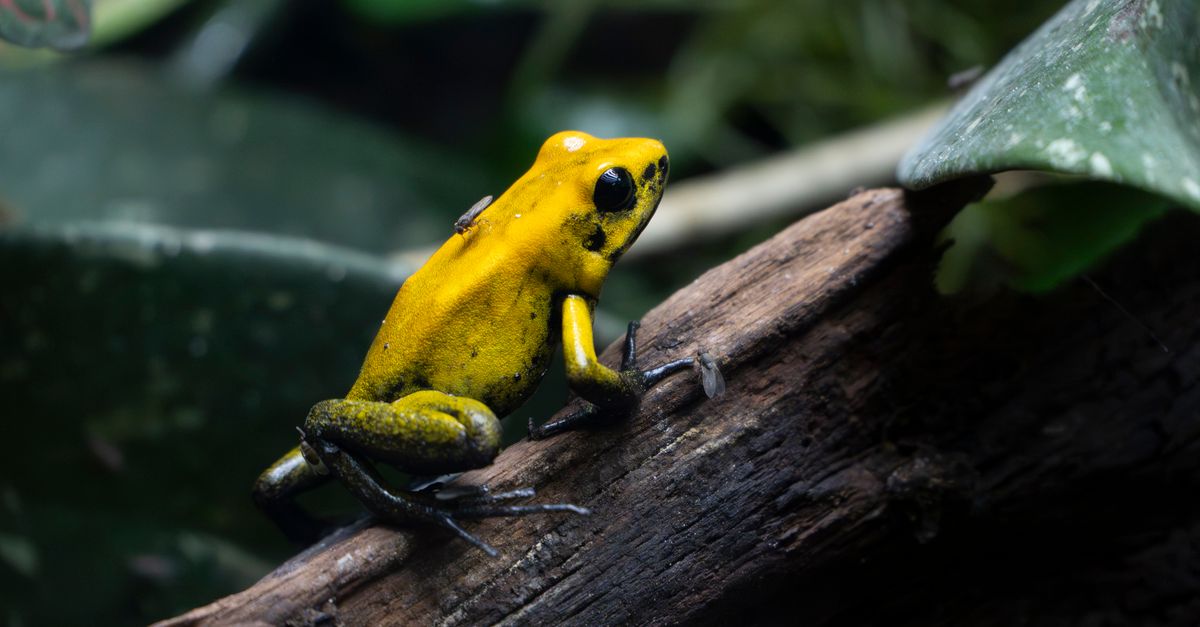
It’s under two centimeters long, it’s venomous, and it just left the scientists studying it thoroughly stumped. Meet Excidobates perplexus. It’s a tiny frog, newly described in Ecuador, that looked, at first glance, like two different species. Spoiler: it isn’t. And its scientific name, which translates roughly to “confusing” or “perplexing,” gives the game away from the start.
One frog, two outfits
The discovery was announced in early October by Ecuador’s National Biodiversity Institute (Inabio). It comes, however, with a neat twist. There are two populations of this frog, separated by about 65 kilometers. And each one wears a completely different “outfit.” In fact, the frogs from the Paute river basin have black bodies with scarlet blotches. Those from the Cordillera del Cóndor, by contrast, sport green backs splashed with irregular yellow patches. At a glance, you’d swear they were two separate species sharing little beyond their size. Both measure just 15 to 18 millimeters, barely the width of a coin.
For a while, in fact, researchers genuinely suspected exactly that. But when they finally compared the DNA of both populations, the result caught them off guard.
Genetics settles it (and confuses everyone)
The genetic analysis showed a difference of just 0.6% to 0.7% between the two populations. That gap is far too small to justify calling them separate species. In other words, it’s the same frog. It just wears two very different outfits, depending on which valley it grew up in. That mismatch between what the eyes see and what the genome says has a curious explanation. It’s exactly why scientists landed on the name perplexus. Still, they were left scratching their heads. And anyone who lines up photos of both color variants side by side will, therefore, understand why.
The males also have a distinctive call, made up of 24 to 26 rapid pulses: a sort of musical stutter. As if the identity crisis weren’t enough, that call also marks territory. And, conveniently, it helps biologists track the frogs down in the leaf litter.
Born straight onto the red list
What could have stayed a quirky lab anecdote has, unfortunately, a much more serious side. Researchers are proposing that Excidobates perplexus be classified directly as Critically Endangered, under IUCN criteria. That’s an unusual fate for a species science has only just met. In fact, the reason is that its habitat overlaps with large mining concessions for copper, gold and molybdenum. This is true, in particular, of the Cordillera del Cóndor population. Meanwhile, add deforestation and wildlife trafficking to the mix, too. Together, they’re two chronic threats facing amphibians across the Amazonian and Andean region.
In short, this frog went straight from “unknown to science” to “on the edge.” It skipped, in the process, the usual middle step of just being an ordinary, unthreatened species. Still, not exactly a dream debut.
Why Excidobates perplexus, a Two-Centimeter Frog, Matters
Relative to its size, Ecuador is one of the most amphibian-rich countries on the planet. However, much of that diversity still hasn’t been catalogued. Every new species described is an important reminder. Moreover, the window to protect these ecosystems is closing faster and faster. And that’s even more alarming when the species turns out to be endangered before it even has a name. This isn’t an isolated case, either. Just weeks ago, scientists described another newly discovered creature in the same country: a horned spider found in Ecuador. It’s proof of just how much remains to be catalogued in the country’s forests. Poison frogs, besides, aren’t just strikingly pretty. In fact, their skin secretions are of real interest to pharmacological research. So, losing a species before we’ve fully understood it means closing a door we never even got to open.
So next time someone claims a frog can’t teach you anything about identity, bring up Excidobates perplexus. One species, two wardrobes. And a pretty serious warning, tucked behind the most honest name given to an amphibian in a long while.
You can read more about the discovery in this report from Primicias.