
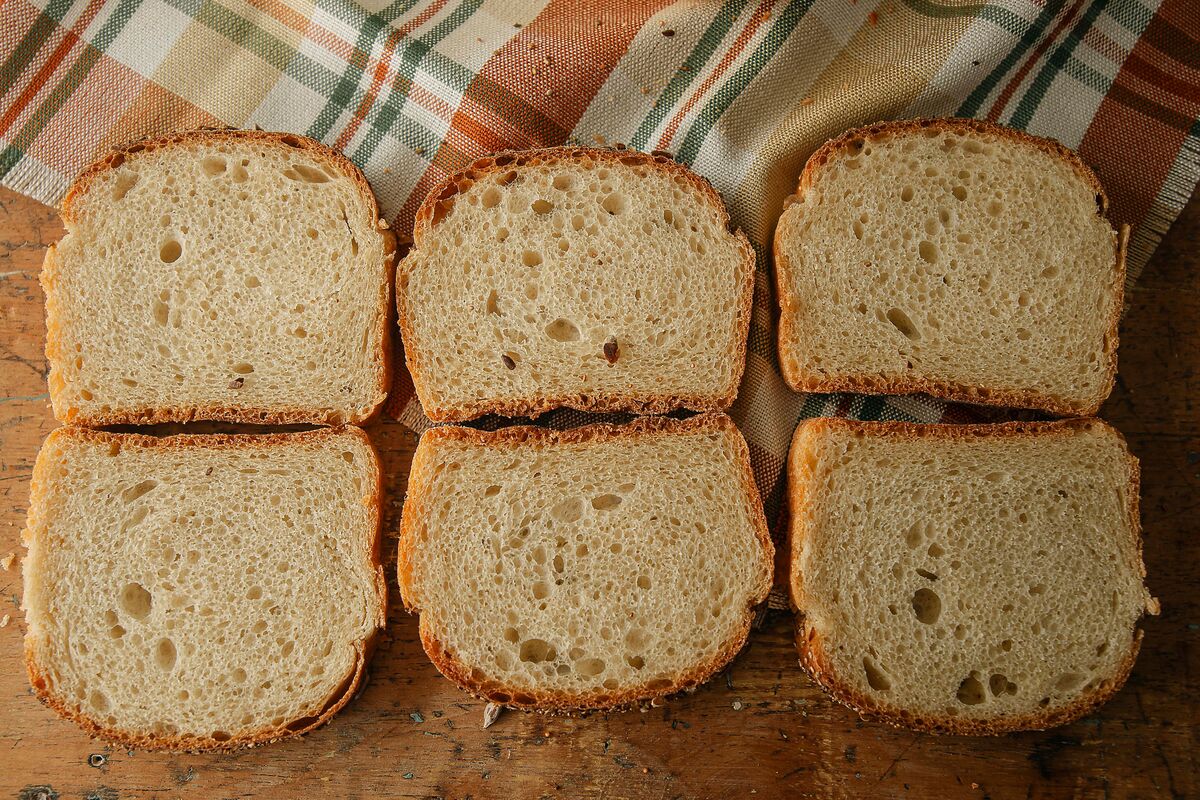
If you want your bread to stay fresh for more than a couple of days, there’s one golden rule almost nobody follows: never put your bread in the fridge. It sounds backwards — if the fridge keeps milk, meat, and leftovers fresh, why wouldn’t it do the same for bread? — but it turns out the refrigerator is pretty much the worst place you could store it. The best spot, oddly enough, is the freezer.
How to do it
- Cut the bread into whatever portions you actually eat in one sitting (slices, half a baguette, whatever works).
- Wrap it tightly in plastic wrap or foil, or seal it in an airtight bag with as much air pushed out as possible. Air is the real enemy here, not cold.
- Freeze it as soon as possible, ideally the same day you buy or bake it.
- When you want some, pull out only what you need: slices can go straight from freezer to toaster, no thawing required.
- For a whole loaf, let it thaw at room temperature still wrapped, then give it 5-10 minutes in a 180°C (350°F) oven to bring the crust back to life.
That’s it. No paper bags left on the counter crossing your fingers, no tucking the loaf into the fridge “so it lasts the week.” That perfectly reasonable-sounding move is exactly what ruins it fastest.
Bread in the Fridge: Why It Actually Works
For years, the assumption was that bread goes hard because it dries out. That’s wrong, or at best a half-truth. Food writer and kitchen-science reporter Daniel Gritzer, at Serious Eats, tested this directly: he baked several loaves and split them between room temperature, fridge, and freezer, some tightly wrapped and some left exposed. Even the loaves sealed airtight — losing essentially no moisture — went just as stale over time. So moisture loss isn’t the main driver.
The real culprit is a process called starch retrogradation. When bread bakes, heat and water scramble the starch molecules in the flour, which is what gives fresh bread that soft, springy crumb. But the moment the loaf starts cooling, those molecules begin drifting back toward their original state, slowly re-organizing into stiffer, more crystalline structures. That re-ordering is, quite literally, what we experience as “stale bread.”
Here’s the catch: retrogradation doesn’t happen at the same speed at every temperature. It’s painfully slow at room temperature, basically frozen solid below 0°C… and fastest of all between roughly 0 and 5°C — which happens to be exactly the temperature inside your fridge. In other words, keeping bread in the fridge doesn’t protect it; it slams the accelerator on a process that would otherwise take days to notice at room temperature. A few hours in the fridge and the loaf can already taste like it’s a week old.
The freezer, on the other hand, works because the starch molecules get locked in place: no movement means no re-organizing, so the staling clock essentially stops. That’s why a well-wrapped loaf can sit in the freezer for weeks and still taste nearly fresh once toasted or reheated, while that same bread wouldn’t survive two decent days in the fridge.
There’s one more neat wrinkle: heat can partially reverse retrogradation. That’s why warming up slightly stale bread in the oven brings back some of its original softness — the heat temporarily scrambles those re-ordered starch chains all over again. It’s the same reason yesterday’s croissant tastes so much better after a quick trip through a hot oven.
So next time you’ve got half a baguette left over, resist the urge to keep your bread in the fridge “where it’s safe.” Wrap it up, freeze it, and let starch chemistry work for you instead of against you. The same logic — shielding food from air and the wrong temperature — is behind the plastic wrap trick that keeps bananas from ripening too fast: sometimes the fridge just isn’t the answer there either.