
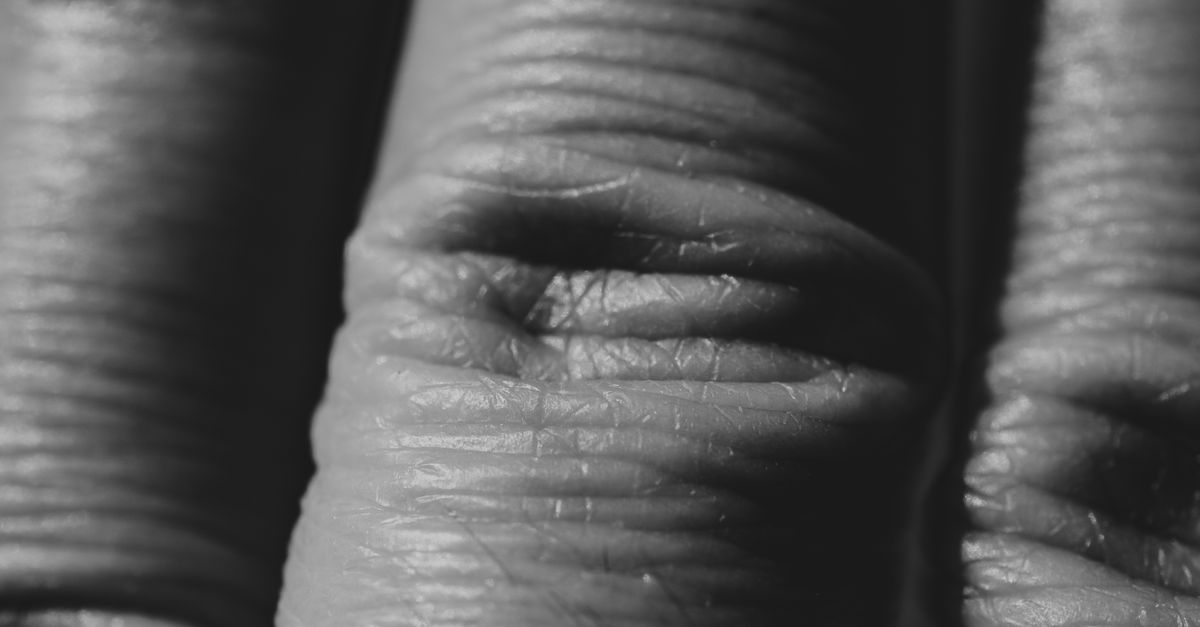
You have probably spent your whole life in the bathtub or the pool assuming your fingers wrinkle because your skin soaks up water, like a cookie dunked in coffee. It is such an intuitive explanation that almost nobody questions it. It is also simply wrong. What happens to your wrinkled fingers after a while in the water is not a passive side effect of hydration — it is an active order from your own nervous system, and it most likely serves a very specific purpose: the same one served by the tread on a tire.
Wrinkled Fingers: Your Body Hitting the Brakes, Not Swollen Skin
The clue that killed the “sponge” theory came from medicine, not the kitchen. Doctors had noticed for decades that patients with damage to the median nerve (the one running through the hand) showed something odd: no matter how long they kept the affected fingers submerged, the skin stayed perfectly smooth. If wrinkling were pure water absorption, it should happen regardless of nerve damage. Since it doesn’t, the explanation had to live in the nervous system instead.
What actually happens is that prolonged contact with water triggers the sympathetic nervous system (the same one behind the “fight or flight” response), which orders vasoconstriction: the blood vessels just beneath the skin of the fingertips narrow. As that underlying layer loses volume, the skin above it, which hasn’t shrunk at the same rate, folds in on itself into the familiar grooves. It is, essentially, a muscle-driven reaction controlled by the brain — not a puddle slowly soaking inward.
A trick with millions of years of road-testing: better grip
The mechanism has been fairly well understood for a while. The interesting question is why, and that’s where a Newcastle University study comes in, published in the journal Biology Letters and still the go-to reference on the subject, as covered by Scientific American. The team, led by neuroscientist Tom Smulders, gathered 20 volunteers and had them transfer glass marbles and fishing weights between containers — first with smooth fingers, then with fingers wrinkled after a 30-minute soak in warm water.
The result was unambiguous: with wet objects, wrinkled fingers moved the pieces 12% faster than smooth ones. With dry objects, the difference vanished entirely — wrinkles neither helped nor hurt. Smulders summed it up with a tidy analogy: the grooves work like tire tread, channeling water away from the contact area so the skin can actually grip the surface instead of sliding over a thin film of liquid.
- Smooth fingers lose no grip on dry objects.
- Wrinkled fingers gain a measurable grip advantage on wet objects.
- The groove pattern isn’t random — it forms along the same lines in each person every time.
The mystery nobody has solved yet
Here’s the part that still puzzles researchers. If wrinkling only brings benefits with wet objects and costs nothing with dry ones, why aren’t our fingertips permanently wrinkled? Smulders himself raised this as an open question — there must be some downside that a two-hour lab experiment simply doesn’t capture. The leading hypothesis is that permanently wrinkled skin would be more vulnerable to cuts, wear, or a loss of fine tactile sensitivity during everyday life, where most of what we handle is dry.
So next time you climb out of the shower looking like a raisin, feel free to be a little smug about it: it’s not a manufacturing flaw, it’s a biological tire system your body switches on exactly when needed — and one that’s been in service long before anyone thought to invent the wheel. Speaking of hand mechanics nobody fully questions, it’s also worth knowing why your knuckles crack, and whether it causes arthritis.