
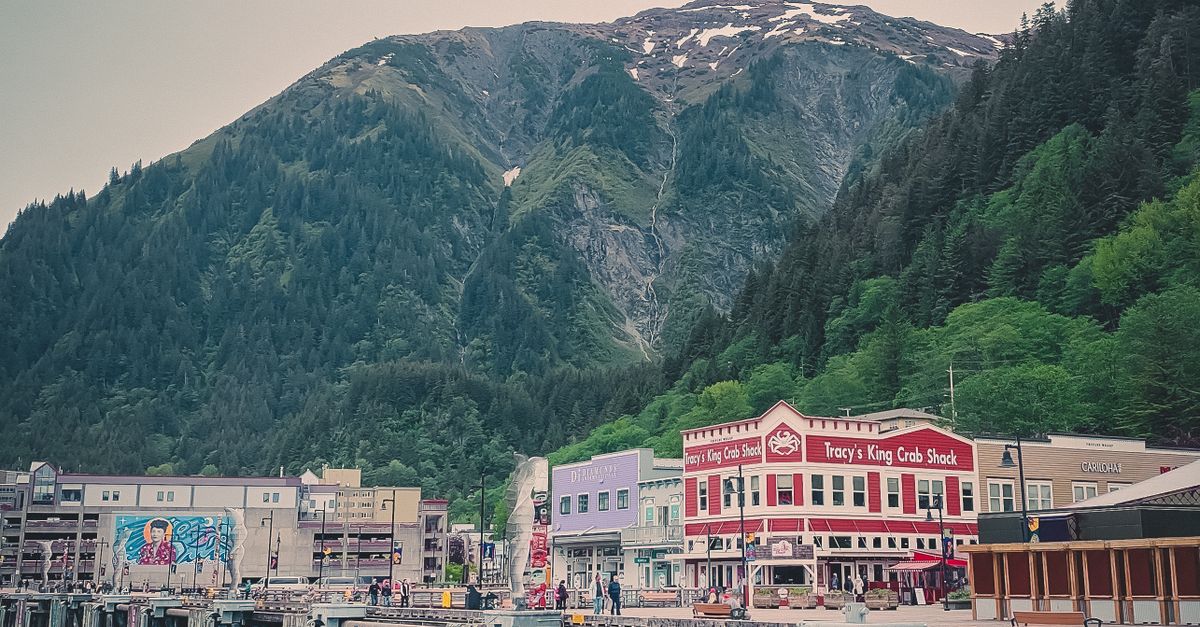
Picture a town where the city hall, the grocery store, the police station, and the church all sit inside the same building. Nearly all of your neighbors’ homes are there too. In Whittier, a tiny Alaskan port wedged between mountains and a fjord, that’s not a quirky thought experiment. It’s literally one entire building acting as a town, home to 85% of its 272 residents (per the 2020 census, up from 220 in 2010).
One Entire Building Acting as a Town
The tower in question is called Begich Towers, and it’s fourteen stories tall. Under its roof you’ll find a grocery store, the post office, the police department, and the mayor’s office. There’s also a small Methodist church, a laundromat, a little hotel, an indoor pool, and even a kids’ play area. “Going downtown” in Whittier basically means taking the elevator.
Still, the building wasn’t originally built for this. It went up in 1957 as a military structure, back then called the Hodge Building. During the Cold War, Whittier served as a strategic Army port, thanks to being one of the few ice-free, deep-water access points in the area. In 1972 it was renamed Begich Towers in memory of Nick Begich, an Alaska congressman who disappeared — and was later presumed dead — in a small plane crash nearby. Over the decades, pretty much the whole town moved in.
The Only Way In — and You Have to Share It With a Train
If living in a building-slash-town already sounds like a movie set, getting there adds another twist. The only road connecting Whittier to the rest of Alaska is the Anton Anderson Memorial Tunnel, about 2.5 miles long and considered the longest highway tunnel in North America. There’s a catch, though: it’s a single lane, so cars and trains have to take turns, alternating direction roughly every half hour. Meanwhile, jet-turbine ventilation clears the air between passes.
Until the year 2000, that tunnel was rail-only. Therefore, the sole ways in or out of Whittier were by boat, small plane, or freight train. Cars have been allowed since then, but with a catch: the tunnel closes overnight, so if you’re running late getting back from a shift in Anchorage, you’re either sleeping in your car or finding a room on the other side of the mountain.
So Why Cram Together When There’s a Whole Forest Out There?
Short answer: the weather. Whittier gets some of the heaviest snowfall in Alaska — several meters piling up most winters — and winds that can top 150 miles per hour. That’s exactly why Begich Towers was engineered to withstand temperatures down to -40°F (conveniently, also -40°C — the one point where both scales agree) and gusts of that intensity. Living inside one entire building, linked by interior hallways, has a clear upside in a storm: a resident can grab milk, walk their kid to school (housed in an adjoining, connected building), or see a doctor without even putting on a coat.
In other words, Whittier’s residents don’t live packed together for lack of space, since they’ve got fjords, glaciers, and forest to spare. They live this way because bundling all the basic services under a single roof turned out to be the most sensible way to survive a winter that seems determined to wipe the town off the map every single year. However, Whittier isn’t the only extreme corner of the planet with unusual rules: a Norwegian town went as far as banning dying within its limits rather than let the environment set the terms.
Eleven months out of twelve, Begich Towers is still the mailing address for nearly everyone in Whittier. It’s an urban-planning experiment born out of military necessity that ended up becoming one of the few places on Earth where one entire building really is a town. You can read more about its history and numbers on the Wikipedia page for Whittier, Alaska.