
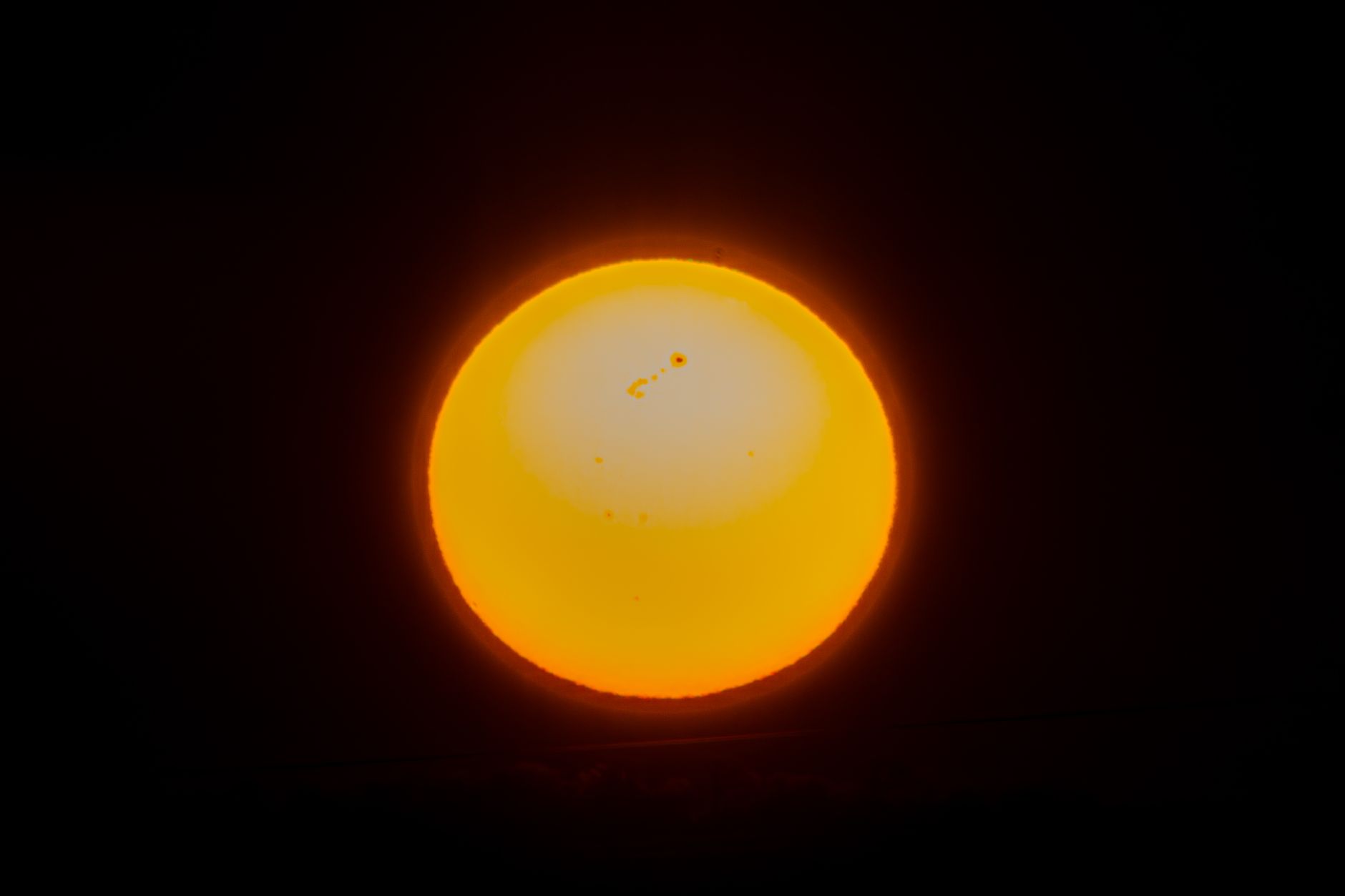
The Sun has been throwing solar flares for about 4.6 billion years. Until now, though, nobody had actually seen where it gets the energy to do it. A telescope perched near the crater of a Hawaiian volcano has just solved the mystery, quite literally. The Sun’s surface is covered in tiny plasma whirlpools. Those whirlpools wring the magnetic field tighter and tighter until it snaps into a flare.
The telescope behind the discovery is the Daniel K. Inouye Solar Telescope, built near the summit of the Haleakalā volcano on the Hawaiian island of Maui. With a 4-meter mirror, it’s the largest solar telescope on Earth. It has also just captured the most detailed images ever taken of the Sun’s surface, detailed enough to pick out structures just 19 kilometers (12 miles) wide on a star that measures 1.4 million kilometers across. That’s roughly like spotting a single grain of sand on a football field, viewed from 93 million miles away.
Whirlpools that wring the Sun like a wet towel
What Inouye photographed are Kelvin-Helmholtz vortices: swirls that form when two layers of fluid slide past each other at different speeds. It’s the same physics behind wind rippling the ocean or clouds curling into spirals over a mountain ridge. The instability has been known in Earth’s atmosphere for over a century. It had even been spotted before in the Sun’s outer corona. Nobody, however, had managed to confirm it directly on the Sun’s visible surface, the photosphere. Until now.
The team, led by solar physicist David Kuridze of the National Solar Observatory, catalogued no fewer than 47 of these vortices in the new images. They range from 25 to 170 kilometers across, spaced roughly 65 kilometers apart. They also spin at speeds of up to 3 kilometers per second. The study was published on August 5 in Nature, with the authors describing it as the first direct experimental confirmation of this phenomenon on the solar surface.
Why tiny whirlpools can trigger solar flares this big
Here’s the interesting bit: solar plasma isn’t ordinary water. It’s an electrically charged fluid threaded through with magnetic field lines. When a vortex forms, it drags those field lines along with it, winding them tighter the way you’d twist a wet towel to wring it out. That twisting builds up magnetic tension, stored energy, waiting to snap. And when it finally does, the release can range from an invisible microscopic flare to full-blown solar flares capable of frying satellites and knocking out power grids.
For decades, solar physicists suspected something like this had to be happening at small scales. That would explain where all that explosive energy comes from. But no telescope existed that could actually “see” structures this small and this fast. Inouye, operating since 2022, finally has the resolution needed. It can catch the Sun red-handed.
Why the timing of this discovery matters
The timing couldn’t be more fitting: the current solar cycle, Cycle 25, is nearing its activity peak in 2026. It’s bringing more sunspots, more solar flares, and more northern (and southern) lights than usual. Understanding exactly how these explosions get “loaded” isn’t just academic trivia. The better scientists understand how the Sun charges up before a geomagnetic storm, the better they can predict when that energy will slam into Earth. That matters because it can mess with GPS, satellite communications, or the power grid.
So next time you glance at a photo of the Sun, don’t assume it’s just a dull orange fireball. Underneath that surface, thousands of tiny whirlpools are twisting its magnetic field like unwitting cosmic plumbers, quietly assembling the next solar flare. Incidentally, it’s not the only recent surprise a telescope has turned up: Saturn’s giant decagon spinning at its south pole is another geometric pattern astronomers are still struggling to explain.