
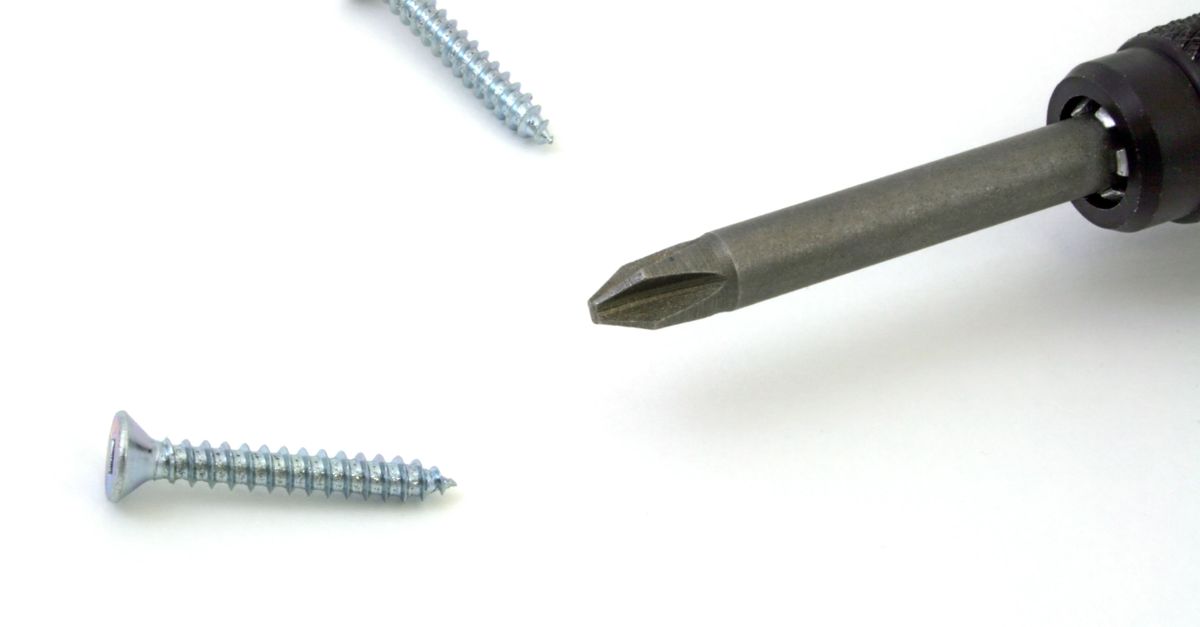
That screw. You’ve turned it a thousand times. The head is rounder than a coin, and the screwdriver just spins in place like it’s on holiday. Before you give up and reach for a screw extractor, or start plotting to saw the furniture in half, there’s an old-school fix. It rescues a stripped screw with nothing but a rubber band, in about thirty seconds.
Here’s the trick: stretch a rubber band over the damaged screw head. Press the screwdriver down onto it, through the rubber, and then turn. It sounds too simple to actually work, but there’s real physics behind it. It’s one of those fixes that’s been floating around DIY sections for years. The Irish Examiner lists it as one of the most effective ways to rescue a stripped screw without any special tools.
How a rubber band rescues a stripped screw
- Find a wide, thick rubber band. Thin office ones snap or just don’t add enough grip. The thick bands used on broccoli or asparagus bunches work great, or any sturdy household elastic.
- Cut it or fold it so it covers the entire screw head. That leaves a layer of rubber between the metal and the metal.
- Press the screwdriver tip right on top and push firmly. That lets it sink through the rubber and into the worn grooves underneath.
- Turn slowly with steady downward pressure, no jerky movements. Push while you turn, don’t just turn.
- If it doesn’t bite on the first try, go for a slightly thicker band, or stack two layers. If the screw is rusted on top of being stripped, a few drops of penetrating oil beforehand make a real difference.
- For screws that are already fully rounded out, where even the rubber can’t get a grip, that’s the point to stop. The honest next step is a screw extractor or a specialty bit, not more of the same technique.
One detail that matters: there’s no need to be gentle. The harder you push the screwdriver into the screw while turning, the better the rubber performs. That’s because it needs to compress against the damaged walls to do its job.
Why it actually works
When a screw head gets “stripped,” its grooves have worn round. Those grooves are the cross, the star pattern, or the straight slot the screwdriver is supposed to lock into. The screwdriver’s metal tip no longer has enough surface to grip against. There’s too much empty space between the two parts, so all that turning force just dissipates as spinning instead of actually moving the screw.
The rubber band solves that exact problem two ways at once. First, it acts as a filler. Pressed into the worn-out gap, it deforms and fills the spaces that used to sit empty between the screwdriver and the metal. That partially rebuilds the groove’s original shape. Second, and more importantly, rubber has a much higher coefficient of friction than metal sliding against metal. Steel skids over steel with almost no grip at all. Rubber, however, bites, compresses, and transmits the turning force instead of letting the screwdriver spin uselessly in the gap.
In DIY terms, it’s doing roughly the same job as a rubber gasket in a pipe fitting. It doesn’t need to fit perfectly; it just needs to deform enough to seal the gap and hold up under pressure. Here, the rubber is playing go-between for two metal surfaces that have stopped understanding each other.
That also explains the trick’s clear ceiling. If the head is completely smooth and round, there’s no irregularity left for the rubber to bite into, no matter how hard it’s compressed. At that point it’s no longer a friction problem you can work around — there’s simply no geometry left to grab onto. That’s where screw extractors come in, since they bite into the metal from the inside, cutting in the opposite direction of the original tightening.
So next time a screw fights you like it’s got a personal grudge, skip the heavy toolbox for a second. Check if you’ve got a rubber band lying around first — it’s free, and it’s in every kitchen drawer. It’s the same logic, in fact, behind the iron trick that erases dents in wood furniture. Try the simple fix you already own before reaching for anything more complicated.