
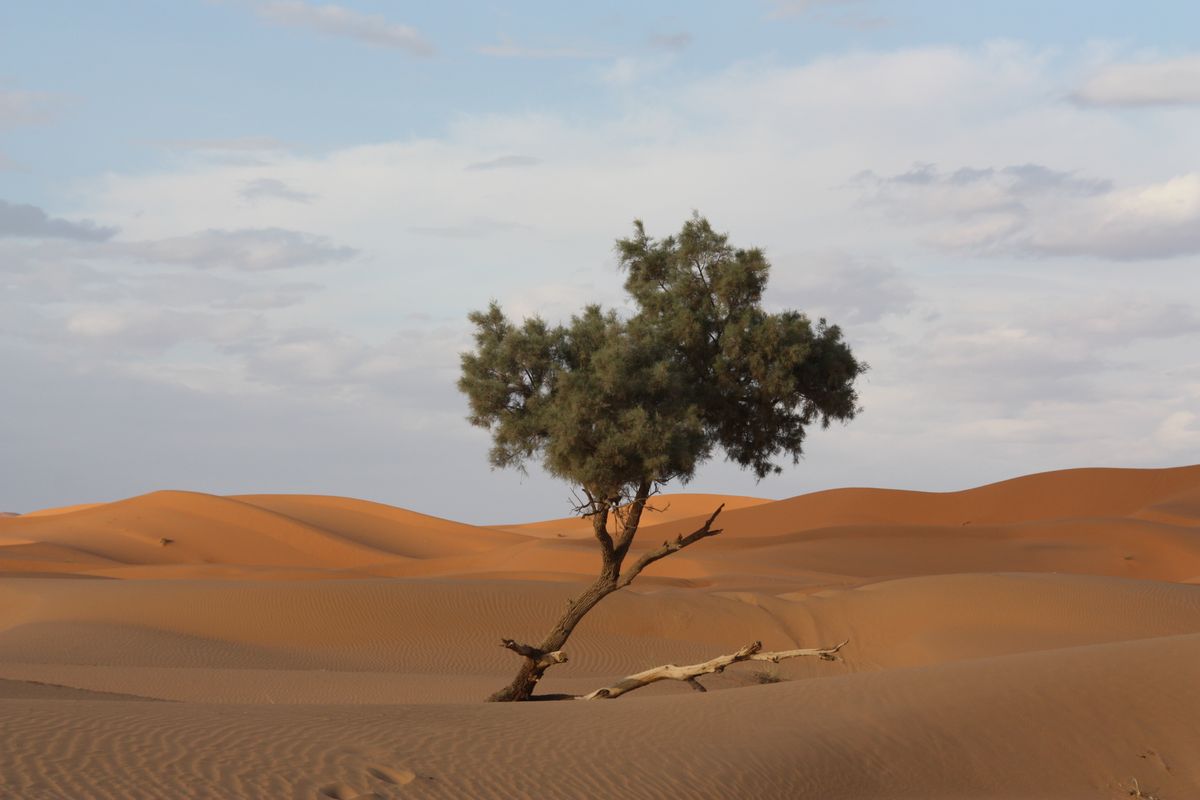
Picture driving for hours through open desert, knowing with mathematical certainty that the nearest tree is over 400 kilometers (250 miles) away. That was life — and, for a long time, survival — around a single tree deep in Niger’s Sahara: the famous Tree of Ténéré, long considered the loneliest tree on Earth. And spoiler alert: its ending was anything but graceful.
300 Years Alone: The Loneliest Tree on Earth
The star of this story was an acacia (sources go back and forth between Acacia tortilis and Acacia raddiana, but they agree on the genus) that had stood, by most estimates, for roughly 300 years in the middle of nowhere in the Ténéré desert, one of the driest patches of the Sahara. There wasn’t another tree of its kind for hundreds of kilometers in any direction, which made this single acacia the only reliable landmark for the camel caravans crossing the route between Niger and Algeria. It was even marked on regional maps — a rare honor for one lone plant.
So how does a tree survive for three centuries with no visible water, in one of the driest places on the planet? During the winter of 1938–1939, the French military dug a well next to the tree to supply travelers passing through, and while drilling they stumbled on the answer to the mystery: the tree’s roots reached down roughly 35 meters (115 feet) underground to tap into a hidden water source. For scale, that’s about as deep as a twelve-story building is tall — except straight down, through solid desert. For generations, this tree had quietly been drilling its own well, and nobody had any idea.
The ending: an entire desert to dodge it, and it still got hit
After surviving centuries of drought, sandstorms, and countless passing caravans, the Tree of Ténéré didn’t die of natural causes. In 1973, a truck driver — reportedly Libyan, and allegedly drunk — pulled off the statistically absurd feat of veering off the track and crashing into the only vertical object for several hundred kilometers in any direction. In the middle of an essentially empty desert, with plenty of room to miss it in any direction, the most isolated tree on the planet was taken down by a traffic accident.
What remained of the trunk was moved to the National Museum of Niger, in the capital, Niamey, where it’s still on display today. On the exact spot where the tree grew for three centuries, a metal sculpture was later installed as a tribute — welded together from recycled pipes, fuel drums, and scrapped car parts: a metal tree standing in for the one real tree that had ever grown there. No replacement was planted, mainly because the conditions that had kept the original alive for so long were nearly impossible to recreate without those 35-meter roots already in place.
These days, the title of “world’s loneliest tree” has reportedly passed to a Sitka spruce on Campbell Island, off New Zealand, whose nearest neighbor sits 222 kilometers (138 miles) away. A fact that will presumably make that spruce extra careful about any roads nearby. It’s not the only extreme-solitude record out there, either: in the Pacific, the 52 Blue whale has been called the loneliest animal in the ocean for more than three decades.