
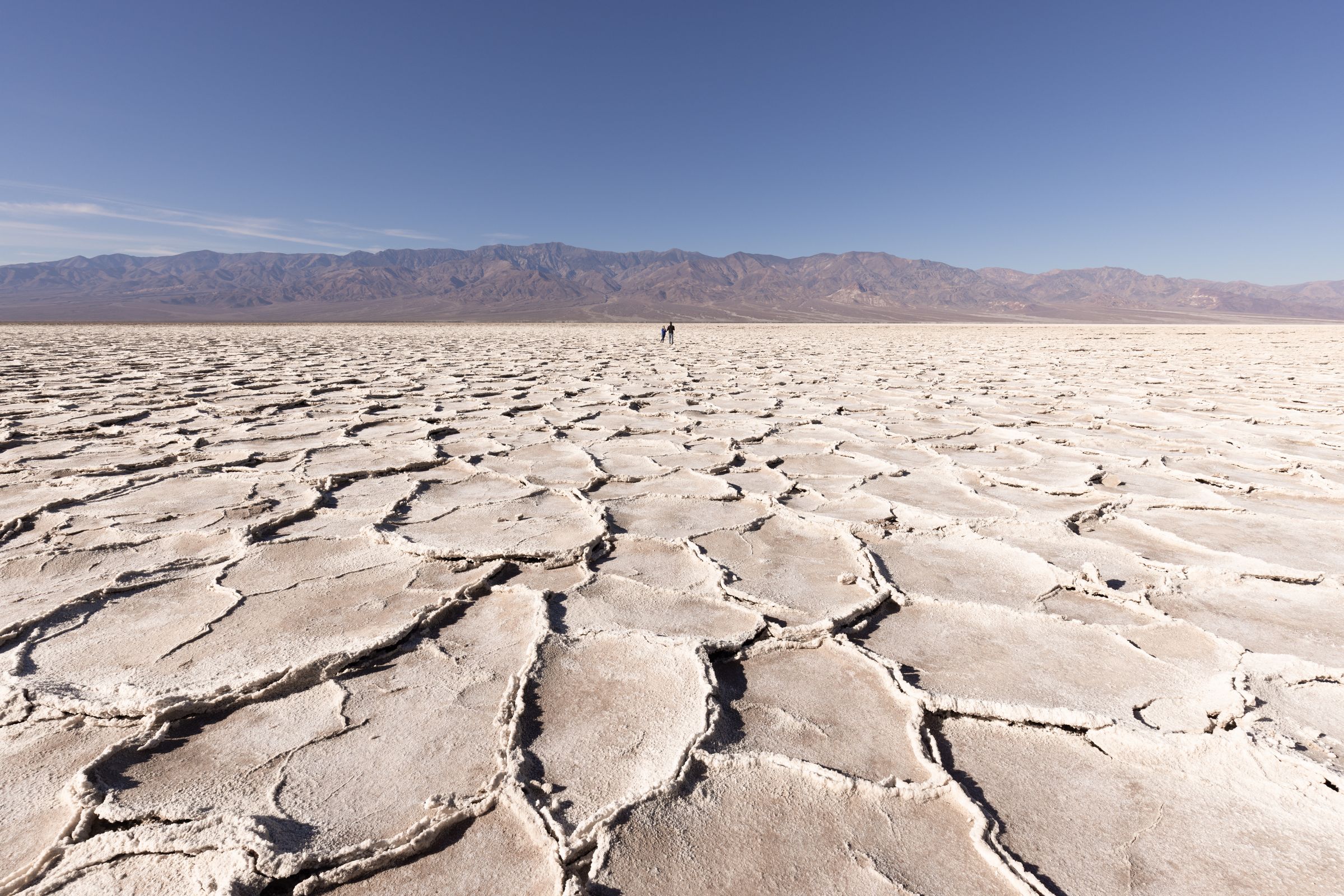
There’s a corner of Death Valley, California, where walking rocks drift across the dry mud on their own. This isn’t a hiking legend or an optical illusion. In fact, hundreds of stones, some weighing over 300 kilograms, leave long, unmistakable trails behind them, as if someone had dragged them across the desert overnight. Nobody has ever actually seen one move in real time. And for more than seventy years, science couldn’t explain how they did it either.
The place is called Racetrack Playa, a perfectly flat dry lakebed inside Death Valley National Park. Since the 1940s, geologists and curious hikers have documented the tracks. Some are straight, others curve or zigzag, and a few stretch for hundreds of meters. Every single one ends at a rock that’s now sitting perfectly still. The mystery attracted every kind of theory imaginable, from serious hypotheses about wind and ice to far wilder guesses. Magnetism, aliens, even some cosmic prank by the desert itself all got their moment.
Seventy Years Chasing a Suspect
Part of the problem is that Racetrack Playa is a brutal, remote place to study. It’s extremely hot most of the year, and rain is scarce. However, when it does rain, conditions shift within hours. Staking out a rock for months, on the off chance it decides to move, isn’t exactly a comfortable research plan. So for decades the phenomenon lived in “it’s probably the wind” limbo. Nobody, still, could actually prove it.
The answer finally came in 2014, when a team led by paleobiologist Richard Norris decided to stop hoping to catch the phenomenon by luck. Norris worked at the Scripps Institution of Oceanography, at UC San Diego. Instead, he set up a small surveillance operation. The team fitted 15 rocks with high-precision GPS trackers and installed a weather station with time-lapse cameras aimed at the playa. All they needed now was patience, and for the exact right conditions to finally line up. Catching walking rocks in the act, in fact, takes a lot of waiting.
The Answer: Ice, Not Ghosts
And line up they did. During an unusually rainy winter, the playa filled with a layer of water. It was just deep enough. Therefore, on cold nights, a thin sheet of ice formed across the surface. Still, it stayed shallow enough to leave the rocks partly exposed. The next morning, as the sun began melting that ice, it cracked into large, thin panels. Researchers, moreover, nicknamed them “windowpane ice.” Even a gentle breeze of just 3 to 5 meters per second was enough to push them across the slick mud underneath.
Each ice panel acted like a sail, shoving along whatever rock happened to be caught in it. It dragged the stone inches or yards, depending on the wind’s strength. Meanwhile, the rock quietly etched its own path into the soft mud below. Norris’s team, therefore, caught it all on camera: rocks creeping along at a snail’s pace, changing direction with each gust. They stopped, however, the moment the ice fully melted. No magic, no magnets, no bored aliens: just textbook physics. All of it paired with the patience to wait for the one day everything lined up.
Why Death Valley’s Walking Rocks Are Still Fascinating
Here’s the fun part: the mechanism has been solved for over a decade now. Still, actually witnessing it remains astonishingly rare. It requires, all at once:
- Enough rain to lightly flood the playa (not exactly common in one of North America’s driest spots).
- A nighttime freeze precise enough to form thin ice — not too thick, not nonexistent.
- A partial thaw the following day that breaks that ice into panels.
- Just the right amount of wind, at just the right moment.
That narrow combination of conditions explains why the puzzle took so long to crack. It’s not that the phenomenon was impossible to explain. It happens, in fact, so rarely each year that almost nobody was ever lucky enough to be watching at the right time. Therefore, other wandering stones around the world have sparked similar mysteries. A good example is England’s Devil’s Arrows, a set of Neolithic standing stones. They, too, traveled a distance that’s hard to explain at first glance. Still, today Racetrack Playa remains a must-see stop for anyone visiting Death Valley. No longer as an unsolved mystery, but as proof of something simple. Walking rocks don’t need ghosts: just a little water, cold, and wind.
1 thought on “Walking Rocks of Death Valley: Mystery Finally Solved”