
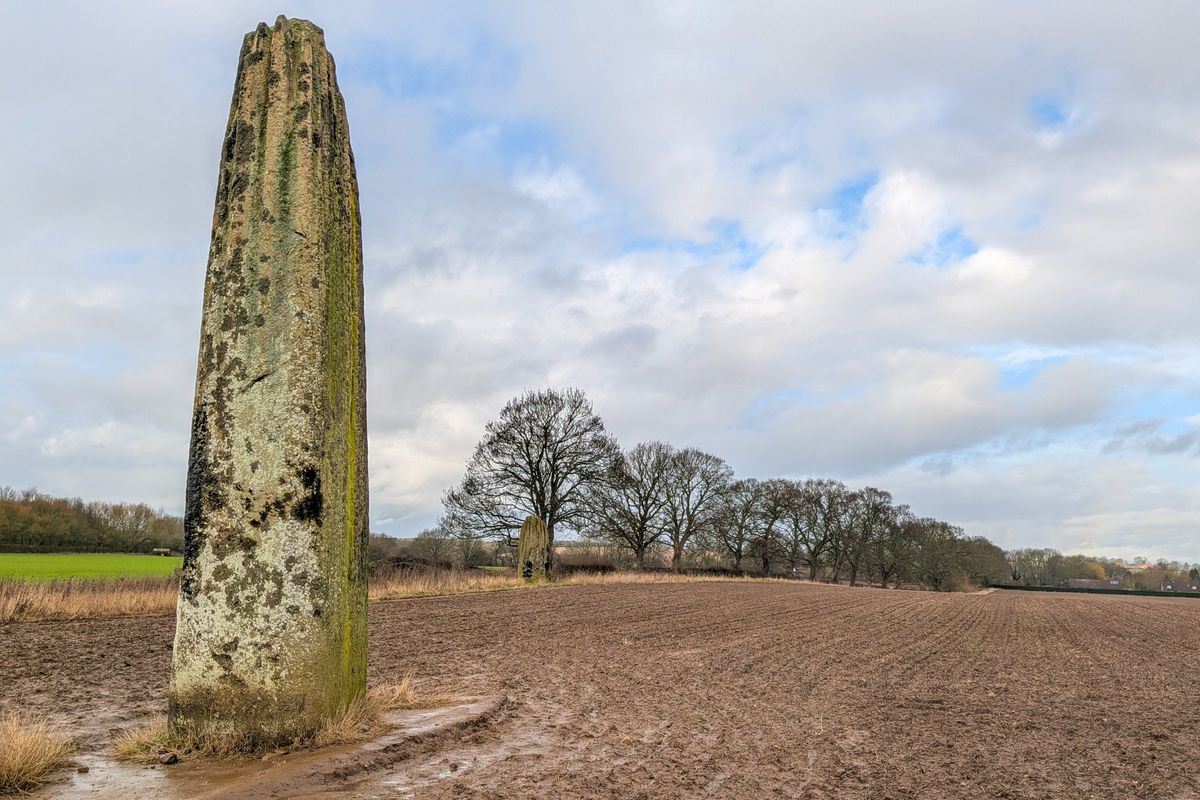
In Boroughbridge, a small Yorkshire town that today sits quietly next to the traffic of the A1, three stones have been giving archaeologists headaches for nearly 4,000 years. They’re known as the Devil’s Arrows, and here’s a fun fact: they’re taller than most of the stones at Stonehenge — up to 23 feet (7 meters) of solid rock standing on end, making them Britain’s tallest prehistoric stone row.
Local legend says the Devil himself hurled them from a nearby hill, trying to flatten the town of Aldborough, and missed. Science, published this week in Proceedings of the Royal Society A, has a less supernatural but equally wild explanation: a group of Neolithic people picked up each one of these giants — about 25 tons apiece, roughly three double-decker buses — and dragged it by hand for at least 11 miles (18 km).
The Mystery of Where the Devil’s Arrows Came From
For decades, archaeologists assumed the obvious source was Plumpton Rocks, a millstone grit outcrop (the same tough, porous sandstone typical of the Yorkshire moors) about 8 miles from Boroughbridge. That made sense: it’s the closest “free” quarry, and moving stones that size without wheels, without draft animals suited to the job, and with only wood and stone tools was already an engineering feat on its own.
However, when a team led by geochemist Anthony Clarke (Curtin University, Australia) together with the University of York decided to check the story with a magnifying glass — an isotopic one, to be precise — Plumpton Rocks didn’t match. They analyzed over 400 microscopic grains of two minerals, zircon and apatite, which work like a geological ID card: their isotopic makeup reveals the exact age of the rock they crystallized in, and that age is unique to each patch of bedrock.
The result pointed, surprisingly, to a place much farther away and over rougher terrain: Brimham Rocks, about 11 miles off. All three stones tested showed the same age signature, meaning they came from the same spot — almost certainly the same quarry.
Why Make Life Harder?
Here’s the part of the Devil’s Arrows story that’s left researchers scratching their heads: if perfectly good sandstone sat closer, why trek that much farther, over tougher ground, with the extra effort that meant for dozens of people hauling ropes and log rollers for days on end? Clarke put it this way: “our research shows these stones weren’t simply taken from the nearest available source — they were deliberately chosen from a challenging landscape 18 kilometers away.”
The team’s leading theory is that where the stone came from mattered as much as the stone itself. Brimham Rocks today is a landscape of oddly shaped rock formations, sculpted by wind and ice into forms that must have looked just as striking 4,000 years ago. It’s easy to picture a place like that being seen as “special,” and hauling a stone from there to the future monument carrying a meaning we can only guess at now — religious, symbolic, a mark of status for whichever community managed to pull it off. A bit like fetching stone from a place of pilgrimage instead of just grabbing it from the yard down the road.
Whatever the exact reason, one thing is clear: Neolithic Britons weren’t just solving colossal engineering problems without metal or the wheel — they were also making design choices based on the symbolism of the landscape, not just convenience. Therefore, the Devil’s Arrows remain, 4,000 years on, as much a symbolic monument as a physical one. If you like stories about stones hiding secrets, don’t miss this medieval ring that turned up under a Norwegian street, which hid a geological secret of its own too. Next time someone complains about driving to the farther IKEA, remind them of this.