
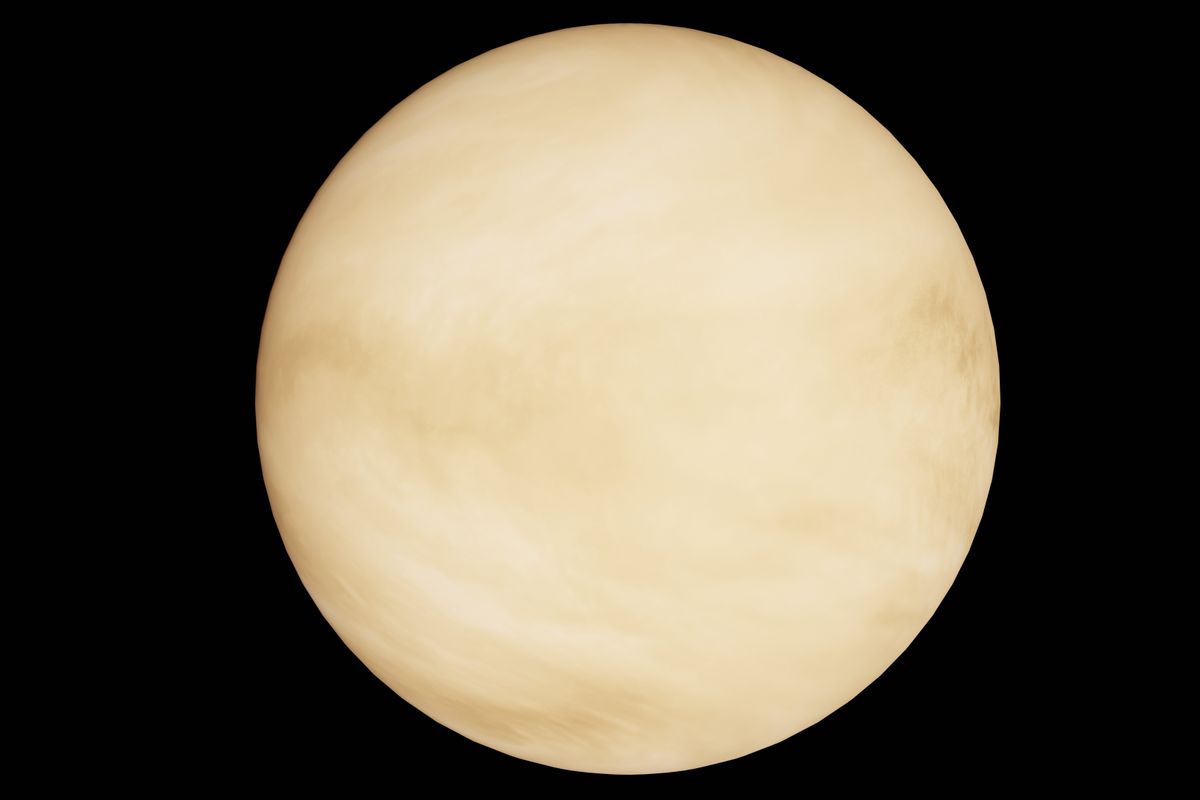
If you had to bet on which planet in the solar system is the hottest, the obvious pick would be the one sitting closest to the Sun, right? You’d lose that bet. Mercury, the innermost planet, doesn’t even make the podium. The title of “solar system’s oven” actually belongs to Venus, which orbits considerably farther out. And the reason why is one of those facts that, once you understand it, you start seeing echoes of on our own planet.
A furnace that shouldn’t be winning
Mercury receives almost double the solar energy that Venus does, so on paper it has a huge head start. By day, its surface reaches around 430°C (800°F) — hot enough to melt tin or lead. Not bad for the “closest one.” But then comes Venus, orbiting the Sun at more than twice Mercury’s distance, and its surface still bakes at an average of 467°C (872°F), day and night, according to NASA. In other words: the planet that gets the least direct “roasting” from the Sun ends up being, by a wide margin, the hottest of the eight.
And here’s the twist that makes it even more infuriating: Venus is completely wrapped in clouds that reflect somewhere between 70 and 75% of the sunlight that hits it — way more than Earth does. Based on that alone, you’d expect Venus to be a bright, chilly world, almost a frozen mirror. Spoiler: it’s the exact opposite.
Blame the atmosphere that won’t let anything out
The reason Venus wins this thermal race without even running it is its atmosphere: it’s made up of 96.5% carbon dioxide and presses down on the surface with 92 times Earth’s atmospheric pressure — roughly what you’d feel 900 meters underwater. That massive CO2 blanket works like the perfect thermal trap: it lets sunlight in freely, but blocks the infrared radiation trying to escape back into space. It’s the exact same greenhouse mechanism we know from Earth, just cranked up to an almost absurd extreme.
The result is that it doesn’t matter whether it’s day or night, or whether you’re near the equator or close to the poles: the surface temperature on Venus stays remarkably constant, because that dense atmosphere spreads and traps heat across the whole planet like a giant pressure cooker that never turns off.
Mercury, the planet with the wild mood swings
Mercury, on the other hand, barely has an atmosphere at all — just a trace so thin that scientists don’t even call it an “atmosphere,” but an exosphere — so there’s nothing there to hold onto any heat. The moment the Sun sets, that heat radiates straight back into space with nothing in the way. That’s why Mercury swings from 430°C during the day to about -180°C (-290°F) at night: a temperature swing of over 600 degrees, the most extreme in the entire solar system. Basically, you’d need a wardrobe for all four seasons on Mercury — in the same day.
As a curious final touch, Venus’s clouds aren’t made of water but of sulfuric acid, and while it does technically “rain” acid at around 48-70 km (30-43 miles) up, those droplets evaporate from the heat long before they ever reach the ground. The surface stays bone dry, slow-roasting forever. The environment is so hostile that the Soviet Venera probes — the only spacecraft ever to land there and send back data — survived a mere 23 to 127 minutes before the heat and pressure tore them apart.
So next time someone claims that “the closer to the Sun, the hotter it gets,” you now have the perfect anecdote to shut that down: in the solar system, what really decides the temperature isn’t distance — it’s how well, or how poorly, a planet knows how to wrap itself up.