
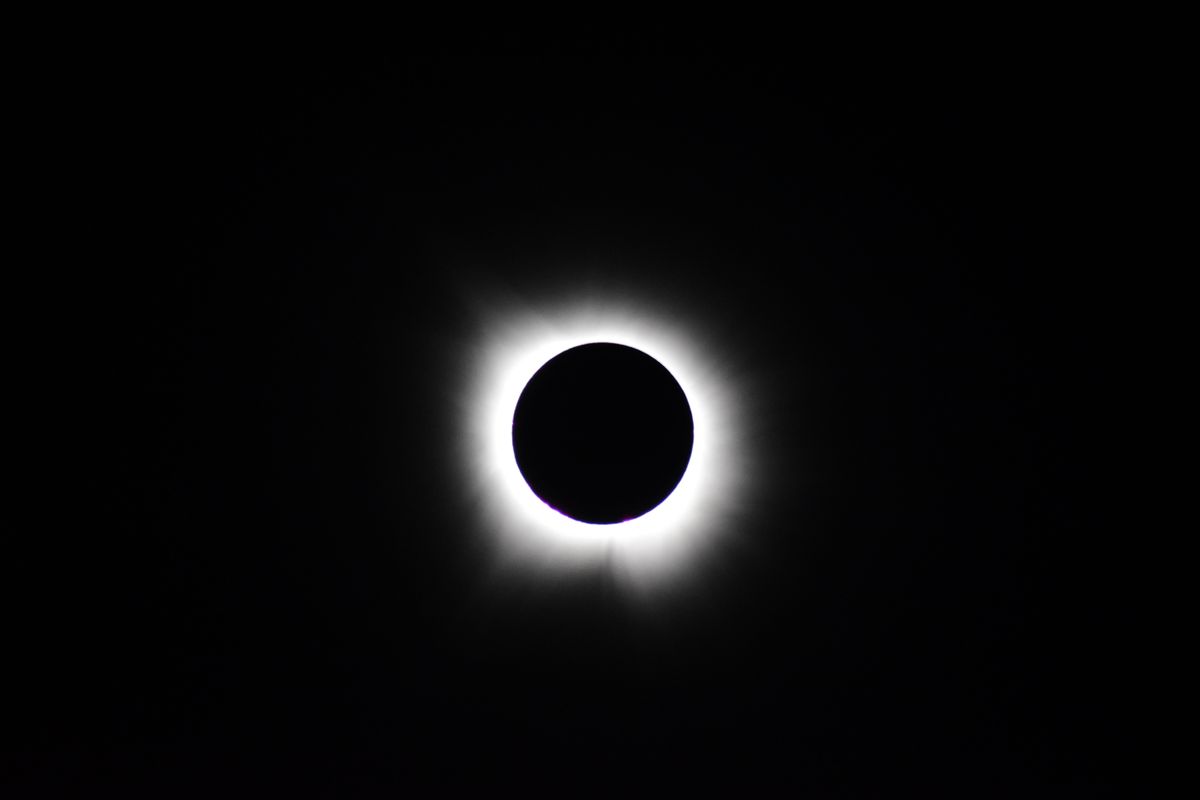
In two days, weather permitting, half of Spain is going to stand around staring at the sky like slack-jawed tourists. On August 12, a total solar eclipse will sweep across the Iberian Peninsula from west to east, and this isn’t just any eclipse: it’s the first total eclipse visible from mainland Spain since 1912. Your great-grandparents probably didn’t even see this one.
A little dusty history
To give you a sense of how rare this is: the last time the Moon’s shadow fully blocked the Sun over mainland Spain, World War I hadn’t started yet. Since then, there’s been exactly one total eclipse visible anywhere in Spanish territory — in 1959, and only from the Canary Islands. So the mainland has been waiting 114 years for this, and the country as a whole, 67.
Total eclipses aren’t rare on a global scale — there’s one somewhere on the planet roughly every year or two. What’s rare is having the narrow band where totality actually happens (about 290 km wide) pass directly over your city. Even though a total eclipse is visible “from somewhere on Earth” fairly often, for any single fixed point on the planet the average wait between two total eclipses is somewhere around 300 to 400 years.
Where it will pass and when
The Moon’s shadow will enter from the northwest of the peninsula and sweep across the country from west to east during sunset. According to calculations from Spain’s National Geographic Institute (IGN), the path of totality will pass over cities including A Coruña, Oviedo, León, Bilbao, Zaragoza and Valencia, as well as Palma de Mallorca. Broadly speaking, the partial phase will begin around 19:30 local time, totality will hit between 20:27 and 20:33 depending on location, and the whole show will wrap up shortly after 21:20, with the Sun already hanging low on the horizon.
That timing detail matters: since it happens almost at sunset, actually witnessing totality will depend just as much on having a clear view to the west as on standing in the right band on the map. A tall building or a poorly placed mountain can ruin the moment even if you’re standing in exactly the right spot.
Totality itself — the brief stretch when the solar disk is completely covered and it’s safe to look up without protection, when the pale halo of the Sun’s corona becomes visible — will last only a minute or two depending on the exact location. Short, but the kind of short that people remember for the rest of their lives.
The astronomical fluke that makes it even better
Here’s the part that sounds like the universe playing a prank: barely a year later, on August 2, 2027, another total solar eclipse will cross the Iberian Peninsula again. Two total eclipses over the same stretch of land within twelve months is unusual enough that even astronomers weren’t expecting the timing to line up quite this closely. And as if that weren’t enough, an annular eclipse — the kind where the Moon doesn’t quite cover the Sun, leaving a blazing “ring of fire” — will also be visible from Spain on January 26, 2028. Three notable eclipses in about a year and a half, after more than a century of nothing.
How to watch it without frying your retinas
The only moment you can look directly at the Sun with the naked eye is during totality itself, and only if you’re standing inside the band where it’s actually total. Outside those few seconds, you need certified eclipse glasses (regular sunglasses won’t cut it, no matter how stylish) or indirect methods, like projecting the Sun’s image through a kitchen colander. If you can’t get certified glasses in time, following it live online is a perfectly good backup plan too.
So if you live anywhere near the path of totality, mark the date, check the forecast ahead of time, and scout out a spot with a clear view to the west. The next time your city gets this lucky, it’s a safe bet none of us will still be around to see it.