
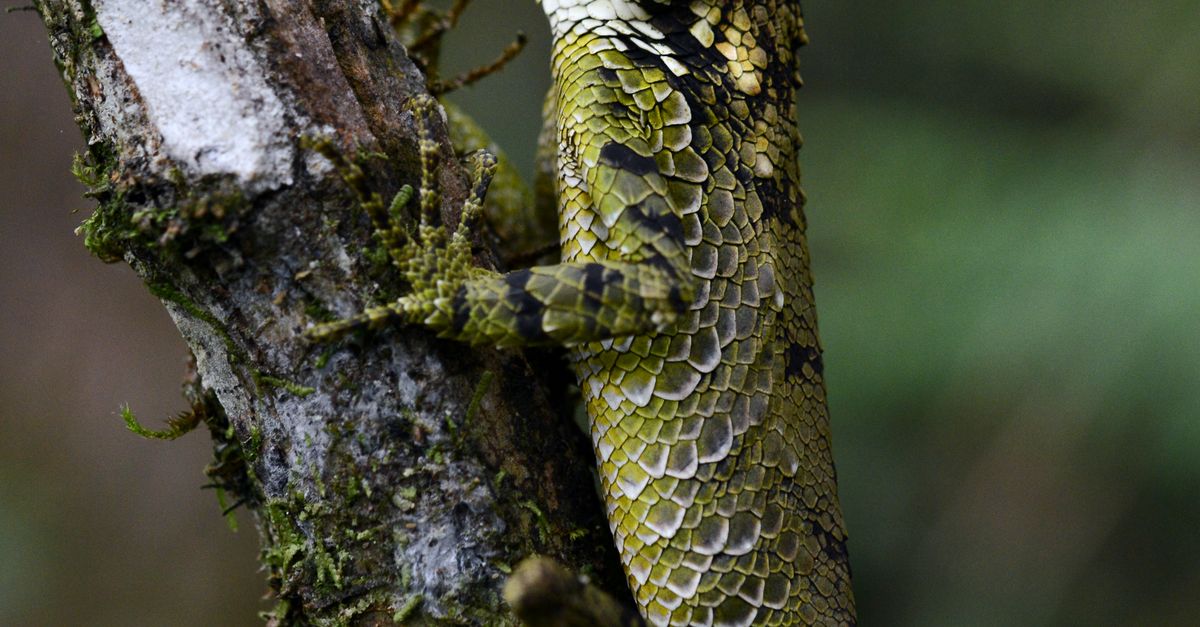
High in the mountains of western Thailand, a team of herpetologists came across a lizard named after Syrax before it even had a name. Above 1,300 meters, they stumbled on a lizard nobody had ever catalogued. It was small and dressed in an unusual greenish-yellow. By all accounts, it also laid surprisingly large clutches of eggs for its size. When it came time to give it a scientific name, the researchers didn’t reach for a Latin dictionary. Instead, they went straight to House of the Dragon.
The animal is now officially Acanthosaura syrax, named after Syrax, Queen Rhaenyra Targaryen’s dragon in the HBO series. However, it’s not just a fan-service flourish. The study’s authors, published in the scientific journal ZooKeys, explain that the resemblance is deliberate. Like Syrax, this lizard shows off that same green-and-yellow palette. Moreover, it’s noticeably smaller than its closest relatives. Despite its modest size, it still manages to produce unusually large egg clutches. A small dragon, but a prolific one.
A lizard named after Syrax that had been hiding in plain sight
Acanthosaura syrax belongs to a group known as “mountain horned dragons,” agamid lizards recognizable by the spiny crest running along their neck and back. In fact, they’re pocket-sized fantasy dragons, long before television made the genre cool. It was found in the evergreen forests of Mae Wong National Park, spanning Tak and Kamphaeng Phet provinces. As far as anyone knows, it lives nowhere else on Earth.
Even at a glance, it stood out to researchers. In fact, it has the smallest neck and back crest scales recorded anywhere in its genus. Moreover, it lacks the dark eye patch seen in several related species, and instead sports a distinctive dark collar. Males show yellowish-green tones around the lips and neck, while females range from pale yellow to orange-brown. However, looks were only the first clue.
DNA sealed the deal
To rule out the possibility that this lizard named after Syrax was simply a regional variant of an already-known species, the team analyzed two separate genes. Then, they compared them against its closest relative, Acanthosaura lepidogaster, as well as every other species in the genus. The results backed up what the anatomy already suggested: this is a genetically distinct, independent species, not just a local quirk.
With this discovery, the genus Acanthosaura now counts 23 known species. In fact, most are scattered across the mountain forests of Southeast Asia. It might sound like a fun aside, but discoveries like this actually matter. Every new species documented in such a narrow habitat is also a reminder of how little we still know about the biodiversity hiding in these mountains. Remember, it’s only ever been spotted above 1,300 meters in this one specific park. Therefore, it’s also a reminder of how fragile such specialized ecosystems are in the face of deforestation and climate change.
Naming species after pop culture isn’t new. There are already spiders named after Star Wars characters and wasps named after superheroes. In fact, there’s even a beetle genus named Luffy, after One Piece’s rubber pirate. Still, rarely does the parallel land this well. Here’s a real dragon, small enough to fit in the palm of your hand, quietly living out its life on a Thai mountainside. Meanwhile, its fictional namesake torches entire kingdoms on TV, and the lizard named after Syrax just keeps climbing its tree in Mae Wong.