
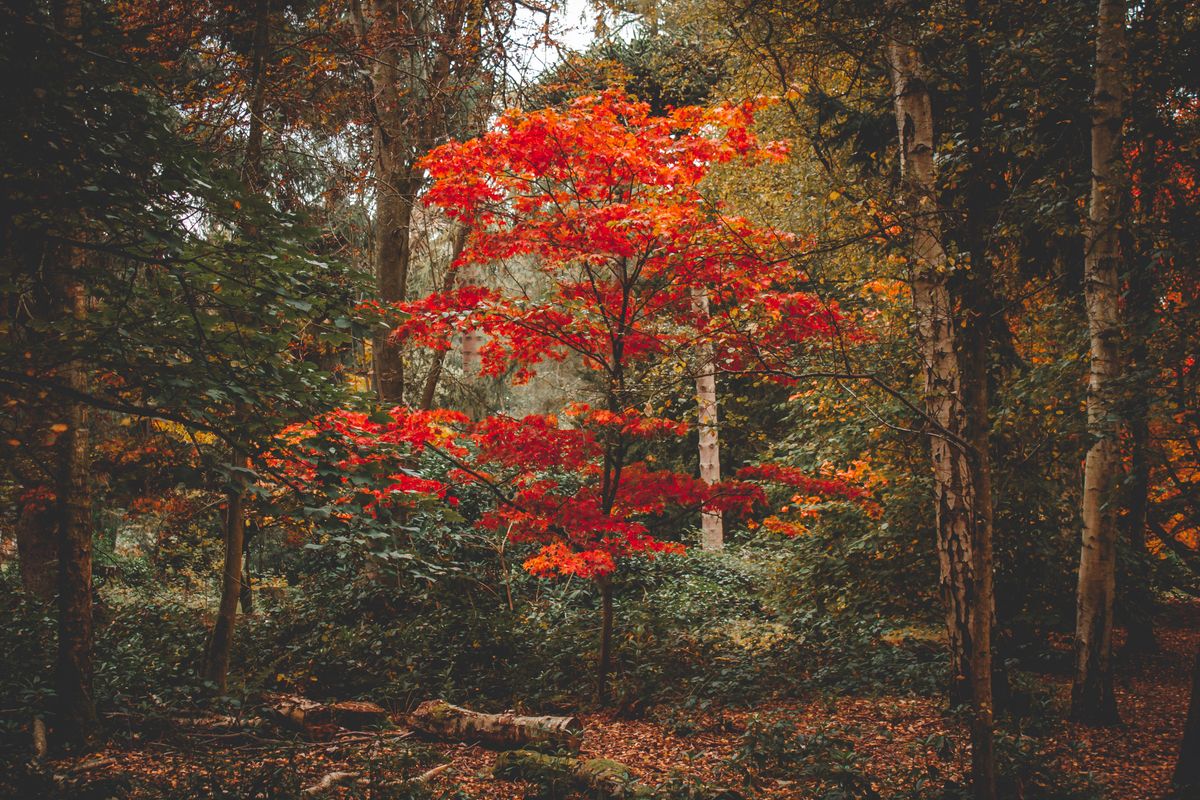
It happens every September: leaves turn red in autumn, right after the yellows and oranges, just before the trees go bald for winter. The textbook explanation we all learned in school is “chlorophyll disappears and other colors show through.” True, but incomplete — it hides the strangest detail of all: red isn’t a color that was hiding there all along, waiting its turn. The tree actually manufactures it on purpose, spending real energy to do so, right when it’s preparing to shut down for the season. It’s like putting on makeup right before the longest nap of the year.
Yellow and orange: colors that were there the whole time
All summer long, a leaf is a chlorophyll factory — that’s the green pigment that captures sunlight for photosynthesis. However, living alongside chlorophyll are other pigments called carotenoids (the same ones that give carrots their color), which have been sitting there all year without anyone noticing, simply because chlorophyll’s green completely hides them.
Once days get shorter, the tree senses the cold is coming and starts dismantling its photosynthetic machinery before frost can damage it: it stops making chlorophyll and breaks down what’s left. As the green retreats, those yellows and oranges that were there since May, quietly disguised, finally get their moment. It’s not magic — it’s just the curtain finally being pulled back.
Why Leaves Turn Red: Built From Scratch
Here’s the part that catches even people who think they know the lesson off guard. Red (and purple) tones come from a different group of pigments called anthocyanins, and unlike yellow, almost no leaf keeps a stockpile of them over summer. The tree synthesizes them from zero, in the leaf’s final weeks of life, using sugar that’s gotten trapped inside.
That happens because, before shedding a leaf, the tree seals off the “pipe” connecting the leaf to the branch, forming a layer of cells at the base of the leaf stalk. Sugars produced by photosynthesis can no longer flow out, they build up, and that trapped sugar combined with strong sunlight triggers anthocyanin production. As both the US Forest Service and the Smithsonian explain, this is why the same tree can show redder leaves on the side that gets more sun: it’s literally producing more “dye” wherever there’s more light to drive the reaction.
So why bother if the leaf is about to fall anyway?
This question has divided botanists for decades: why spend energy making leaves turn red in autumn if the leaf is going to drop off anyway? At first glance, it looks like an absurd waste from an evolutionary standpoint. There are two leading theories, and they aren’t mutually exclusive:
- The sunscreen theory: anthocyanins may act as a filter protecting leaf tissue from excess light while the tree is still reabsorbing valuable nutrients (nitrogen, phosphorus) before letting the leaf go. Without that protection, too much light combined with cold could damage cells before the tree finishes “recycling” what it wants to keep.
- The insect-signal theory: intensely red foliage might work as a kind of billboard telling aphids and other pests “this tree is healthy and well-defended, lay your eggs somewhere else” — an honest signal of vigor meant to scare off next year’s pests.
It isn’t the only case of a plant manufacturing a substance at the worst possible moment purely to defend itself: onions do something similar the moment you slice into them, releasing an irritant compound in self-defense. Whatever the real reason, intense red clearly isn’t free: it costs resources, so it must be paying the plant back somehow.
Why some autumns are more spectacular than others
If you’ve ever wondered why one year leaves turn red in autumn like a postcard and the next the trees just turn a dull brown and drop their leaves with zero flair, the answer lies in the weeks of weather beforehand. The winning combo is sunny days and cold nights without hard frost: daytime sun keeps generating sugars in the leaf, while nighttime cold slows their escape to the rest of the tree, trapping more sugar and triggering more anthocyanin. A cloudy, rainy autumn, or one hit by early, harsh frosts, tends to give duller colors, because chlorophyll breaks down too fast to let much red pigment build up.
So next time you step on a carpet of fallen leaves — the ones that turn red in autumn instead of just fading to brown — know that you’re not just looking at a leaf’s “death” — you’re looking at its final, deliberate, and fairly expensive chemical act: a plant signing off the year with more style than we usually give it credit for.