
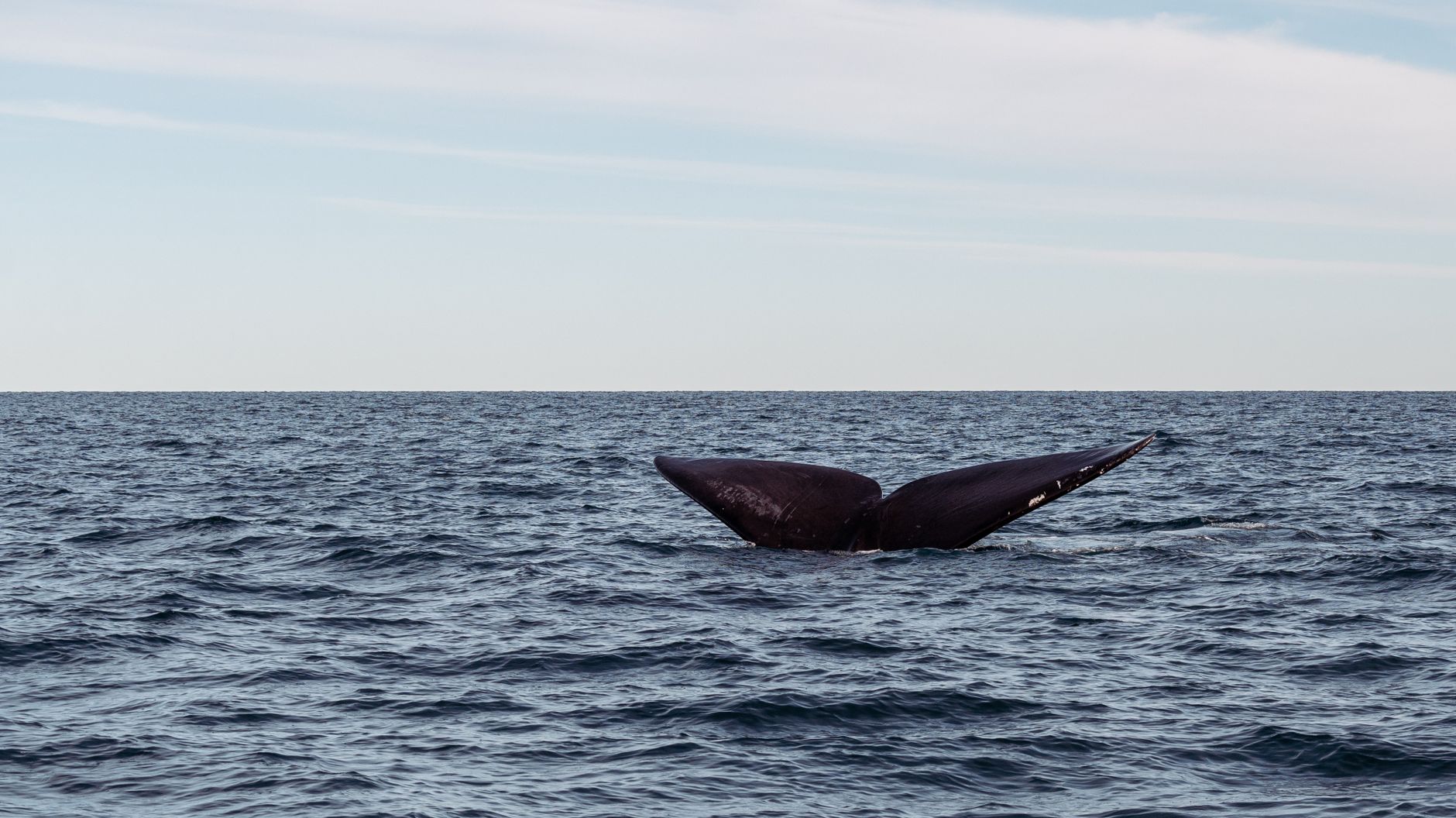
Since 1989, a whale in the North Pacific has been singing at a frequency no other marine animal seems to share. Scientists call it 52 Blue, or simply “the 52-hertz whale.” For more than three decades, researchers have tracked it without ever laying eyes on it: they’ve only ever heard it.
The story starts with military hydrophones. During the Cold War, the US Navy used a network of underwater sensors to track Soviet submarines. In 1989, that network picked up a strange song. It was powerful, with the rhythmic pattern typical of a large whale. However, it came in at 52 hertz — a frequency that matched nothing known. Once the recording was declassified, it reached civilian researchers. That’s when NOAA’s Pacific Marine Environmental Laboratory started studying the 52-hertz whale in earnest, alongside the National Marine Mammal Laboratory.
Why is the 52-hertz whale so strange?
To understand the anomaly, you need a baseline for comparison. Blue whales typically sing between 15 and 20 hertz; fin whales, between 15 and 30. Our whale’s voice sounds, by contrast, almost high-pitched. It’s still far deeper than a human voice, but well above the usual range for large baleen whales. Picture a choir of basses with one singer clearly off in a different register. Still, you can hear him just fine — he just doesn’t blend with anyone else.
Biologists have spent years debating what it actually is. The leading theory is that it’s a hybrid male: a cross between a blue whale and a fin whale. These two species share habitat and, in fact, occasionally interbreed in the wild. In fact, a hybrid like that would inherit a vocal apparatus different from either “purebred” parent, which would explain such an unusual pitch.
The “loneliest whale in the world”
The nickname took off in the 2000s, once the story hit the press. Later, it inspired the documentary The Loneliest Whale: The Search for 52 (2021). It’s an evocative image: an animal that has spent decades singing into the vastness of the ocean. Nothing on its own frequency has ever answered back. Its migration routes, moreover, line up in both time and space with those of blue and fin whales. Still, that means it swims right alongside them without them ever seeming to recognize it as one of their own.
More recent research, though, complicates that tearjerker narrative considerably. As a Smithsonian Magazine report points out, several researchers argue the 52-hertz whale probably isn’t alone at all. Singing in a different pitch doesn’t necessarily mean other whales can’t hear or interact with it. Moreover, whales also communicate through behavior and proximity, not just the exact frequency of their main call. Having an unusual voice isn’t the same as being isolated. It’s much like someone with a strong accent, who can still hold a perfectly normal conversation.
A mystery that’s still open
Here’s the curious part: since 2004, recordings show its frequency has been drifting slightly lower over time. Meanwhile, that same trend is also seen in other large whale populations. It could be tied to the animal’s age or to changes in its body size. It might also simply reflect the broader recovery of cetacean populations after the end of large-scale commercial whaling. And there’s another twist: that signature call hasn’t been detected since 2012. That’s according to NOAA’s latest review of its acoustic archives. Therefore, nobody knows for sure what happened. The animal may, in fact, have died, changed its vocal behavior, or simply stopped passing through the areas covered by the hydrophones.
It’s not the only biological mystery that has taken decades to crack: the MAL blood group went nameless for 50 years, until scientists finally pinned it down.
So next time someone tells you it’s “the loneliest whale in the world,” you can push back with the actual data. Still, the 52-hertz whale might have a voice that’s one in a million, but that doesn’t automatically make it the Greta Garbo of the ocean. Sometimes sounding different just means that — sounding different, not being alone.