
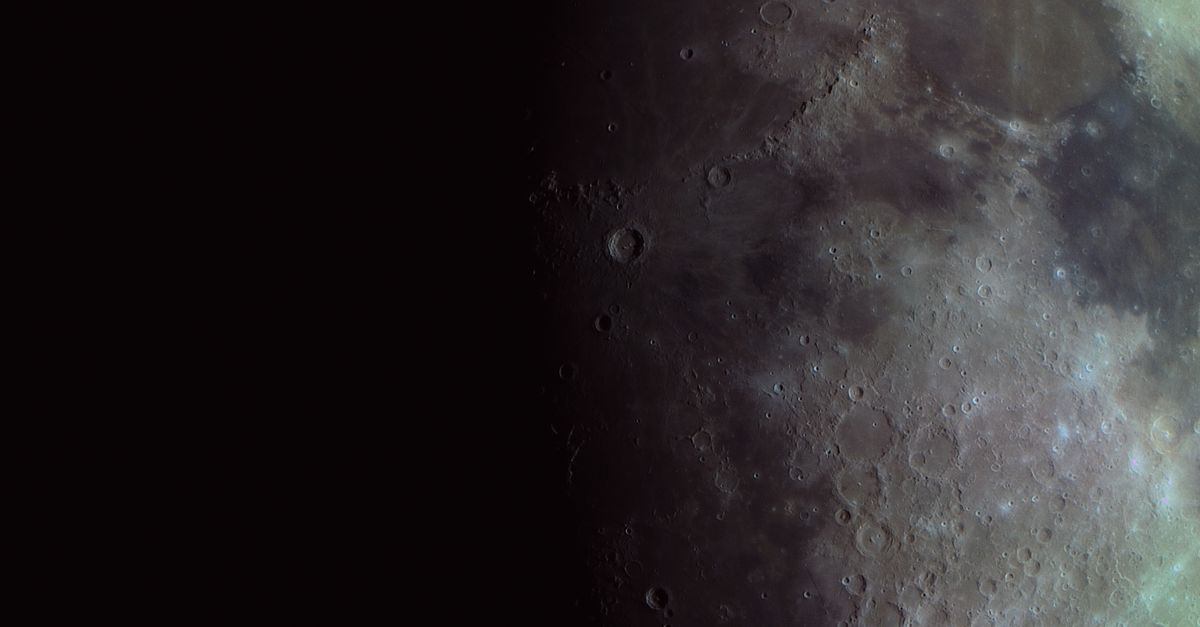
In May 2024, a new lunar crater formed when something slammed into the Moon hard enough to punch a hole more than 220 meters wide and fling debris across an area over 100 kilometers wide. In fact, nobody noticed at the time. NASA’s Lunar Reconnaissance Orbiter (LRO) photographed the site with its wide-angle camera shortly after, but the image sat buried among the millions of frames the spacecraft beams back every month. It took more than a year before anyone looked closely enough to realize that a brand-new crater had appeared where there hadn’t been one before.
The discovery, confirmed in early 2026 and reported by outlets including Scientific American, isn’t just any crater: it’s the largest freshly formed crater ever documented anywhere in the solar system. It’s three times bigger than the previous record, which LRO itself had spotted a decade earlier.
LRO has been orbiting the Moon since 2009, repeatedly photographing nearly its entire surface specifically so scientists can compare “before” and “after” shots and catch changes like this one. It’s needle-in-a-haystack work: the spacecraft produces so much imagery that many discoveries, this new lunar crater included, don’t surface right away but months or years later, once someone — human or algorithm — combs back through the archive with fresh eyes. This kind of delayed discovery isn’t unusual in space exploration: something similar happened with Ariel, the moon of Uranus whose hidden ocean went unnoticed for decades in Voyager 2’s own data.
The new lunar crater that gave itself away with cold
In fact, how it was found is almost more interesting than the crater itself. The impact — likely a fragment of an asteroid or comet just a few meters across — churned up so much fresh rock from beneath the lunar surface. That left behind a kind of thermal “scar” roughly 7 kilometers wide around the impact point. That newly exposed material holds onto heat differently than the Moon’s usual ancient dust, so during lunar nights it cools off faster and shows up as a cold spot in infrared images. It was that exact thermal anomaly that tipped scientists off to go back through older photos — and confirm that, sure enough, a crater now sat where none had a year before.
The final numbers: about 222 meters wide and 43 meters deep, with ejected material scattered across a radius of more than 100 kilometers. To put that in perspective, it’s a hole nearly as wide as two football fields laid end to end, blasted open in a matter of seconds.
Why NASA cares so much about one hole in the Moon
Scientists estimate an impact this size happens, on average, only once every 132 years anywhere on the lunar surface. Being able to document one in near-real time — pinning down its formation date to within a few weeks — turns the crater into a rare natural laboratory. It has since been named in honor of Thomas McGetchin, a former director of the Lunar and Planetary Institute in Houston. It lets researchers study how freshly fractured lunar soil behaves, something that until now could only be inferred from craters thousands or millions of years old.
However, that’s not just academic trivia. NASA is literally scoping out the ground for future crewed outposts under the Artemis program. Understanding how often — and how violently — these impacts hit, hurling rock and dust at high speed over long distances, is therefore directly relevant to deciding where and how to build installations that stay safe over the long haul.
So next time you look up at the Moon on a clear night, remember that its face, seemingly unchanged for eons, is actually still rearranging the furniture every once in a while. It’s just that, until now, we almost never caught it in the act of forming a new lunar crater.