
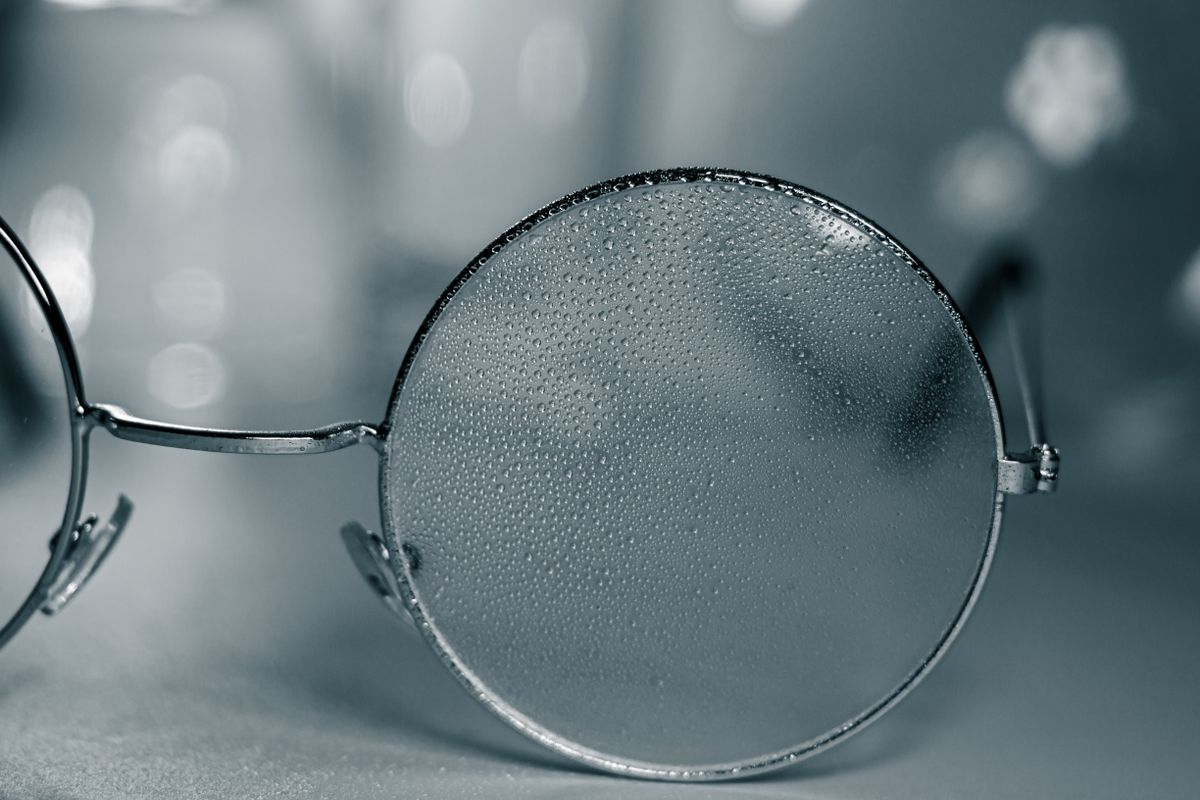
This soap trick is simple. Rub a drop of dish soap onto your glasses (or the bathroom mirror) with a dry cloth. Buff it until the residue disappears, and that’s it — they’ll never fog up again.
If you wear glasses and a mask, you know the drill. You breathe out, the warm air rises, and within two seconds you’re staring at a wall of mist. Meanwhile, the same thing happens to the mirror after a hot shower. But it turns out the fix isn’t some miracle product from the pharmacy — it’s plain soap. The reason it works, however, has more physics packed into it than you’d expect.
How to do it
- Put a small drop of plain dish soap (no lotion or moisturizing additives, which leave a greasy residue) onto a dry microfiber cloth.
- Gently rub the entire surface of the lens, both sides if you’re treating glasses.
- Keep buffing with the same cloth until the soap film is invisible to the eye. No streaks, no haze.
- Repeat every few days, or right before any activity where you know you’ll be breathing hard or moving from cold to warm — working out in a mask, cooking over steam, diving.
No dish soap on hand? Shaving cream works on the exact same principle. Moreover, it’s the classic go-to for bathroom mirrors.
Why the soap trick actually works
Fog is nothing more than water vapor that loses energy when it hits a cold surface — your lens or the mirror — and condenses. The real problem is how it condenses. Because of surface tension, water would rather clump into thousands of tiny, nearly spherical droplets. That happens instead of spreading out into one even layer. Each of those droplets acts like a microscopic lens, bending light in its own slightly different direction. Therefore, the combined effect is that opaque haze that makes it impossible to see anything.
That’s where soap comes in. It’s a surfactant: its molecules have one end that clings to the glass and another that’s attracted to water. Moreover, they wedge themselves between water molecules, weakening how strongly those molecules stick to each other. In fact, that weakening is exactly what surface tension is. Without that tension, water has no reason to form beads anymore — instead, it spreads into a thin, continuous film. A flat sheet of water, as a result, lets light pass through far more evenly than thousands of curved droplets do. Therefore, the glass stays clear even though the same amount of moisture is sitting right there on top of it.
The science team at The Naked Scientists, a science communication program out of the University of Cambridge, explain it well. Soap, they note, doesn’t get rid of the water vapor — it just forces it to behave differently once it lands on the surface. And this isn’t some unverified kitchen hack: NASA developed the first real anti-fog treatments during the Gemini program in the 1960s. It did so to keep astronauts from losing visibility inside their helmets, applying this exact same surfactant principle to visors and lenses.
That said, not all soaps are created equal. The ones loaded with lotions or added oils — very common in “moisturizing” hand soaps — leave a greasy layer. That layer does the opposite of what you want: it smears the glass instead of clearing it. That’s why plain dish soap, with no extras, tends to work best. Moreover, it’s basically free compared to the anti-fog sprays sold at sporting goods stores, which are really just similar surfactants in fancier packaging.
So next time your glasses fog up in the middle of winter, now you know: it’s not magic. Still, it’s everyday chemistry hiding under your kitchen sink.