
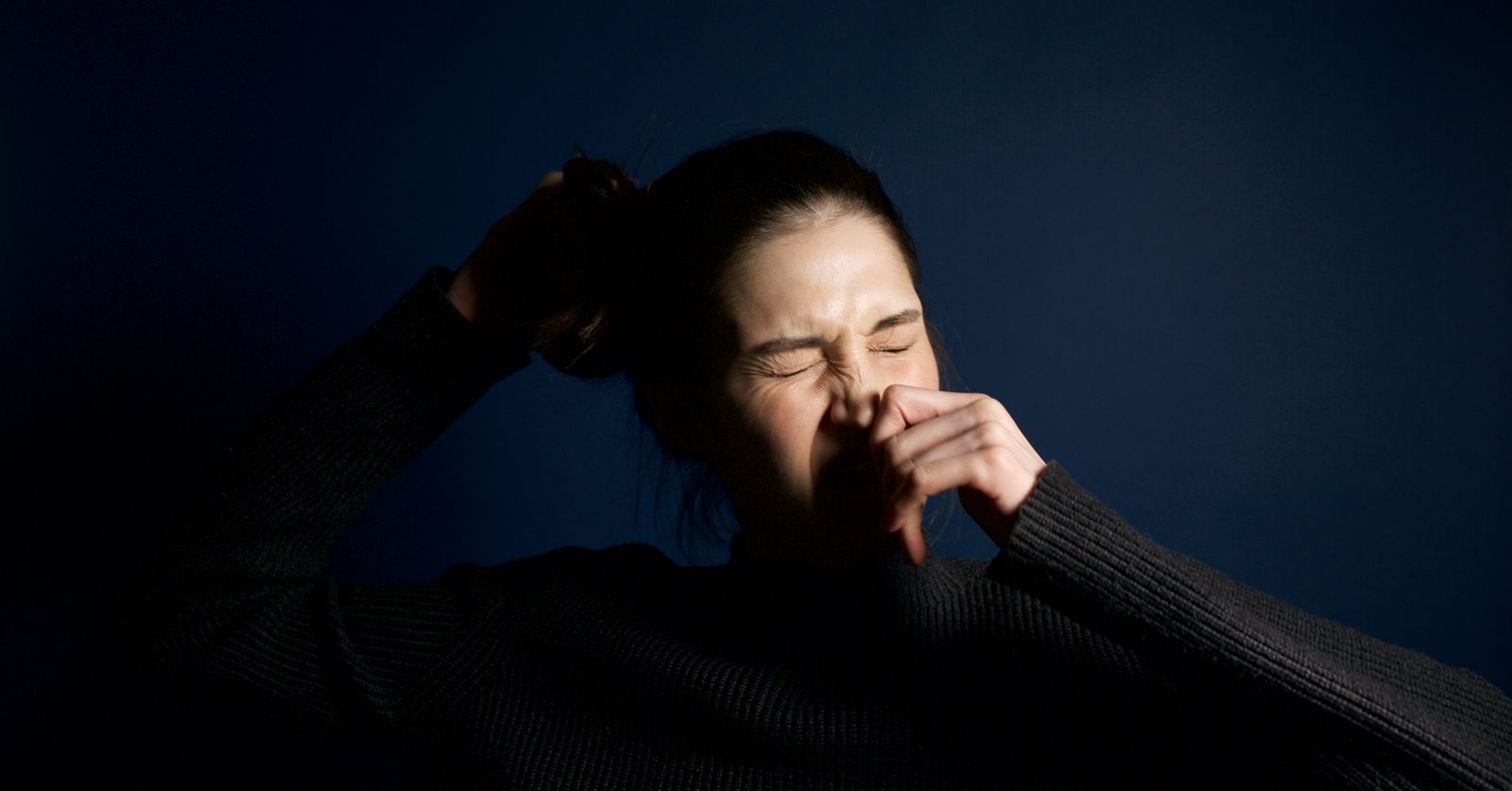
You step outside on a blindingly sunny morning, take off your sunglasses to check something, and out of nowhere: achoo. No cold, no pollen in sight, nobody tickled your nose. The light itself made you sneeze. If that sounds familiar, you’re not broken or weird — you belong to a fairly large club that science has been trying to fully explain for over two thousand years.
The phenomenon has an official name, and it’s one of medicine’s best acronyms: ACHOO syndrome (Autosomal dominant Compelling Helio-Ophthalmic Outburst). Someone clearly worked hard to make that spell out “achoo.” More formally, it’s also known as the photic sneeze reflex, and studies suggest it affects somewhere between 18% and 35% of the population — meaning roughly one in three people you know might sneeze walking out of a dark movie theater into bright sunlight.
ACHOO syndrome: a crossed wire in the brain
A “normal” sneeze is a pretty simple reflex: something irritates the inside of your nose, the trigeminal nerve sends the signal to the brainstem, and the brainstem orders a high-speed blast of air to clear your airway. Straightforward enough.
What’s strange about ACHOO syndrome is that the trigger has nothing to do with your nose at all — it’s a sudden change in light picked up by the optic nerve. The leading hypothesis is that, in some people, the signals carried by the optic nerve and the trigeminal nerve travel close enough together inside the brain that a kind of short-circuit happens: the “whoa, too much light, suddenly” signal leaks into the circuit that triggers sneezing. A brain-imaging study published in PLoS ONE found that people prone to this reflex also activate areas of the cerebral cortex that don’t normally take part in an ordinary sneeze — suggesting it isn’t a simple brainstem reflex, but something more complex that scientists still haven’t fully mapped out.
It’s in your genes (though we don’t know exactly which ones)
What does seem clear is that ACHOO syndrome runs in families. When one parent sneezes at the sun, their children tend to do it too, in a pattern consistent with autosomal dominant inheritance — inheriting the variant from just one parent is enough to get the trait. A large genetic study, summarized by consumer-genetics company 23andMe, found that a variant near the ZEB2 gene raises the odds of being a “sun sneezer” by roughly 30%, and other research points to the NRF2 gene as another suspect. But no single gene explains the whole picture: everything points to this being a polygenic trait, with dozens of small genetic variants each contributing a little, similar to how eye color or height work.
Harmless — but not always inconsequential
The good news is that, aside from the momentary startle or embarrassment, ACHOO syndrome carries no medical downside. It also has a surprisingly long and entertaining history: the Greek philosopher Aristotle already wondered why staring at the sun made people sneeze, and in the 17th century, Francis Bacon tried closing his eyes before looking at the sun to see if the sneeze would disappear. It didn’t entirely — but Bacon wrongly blamed it on heat entering through the eyes and warming the inside of the nose.
Where it’s worth actually keeping in mind is in a handful of very specific situations: fighter pilots and surgeons are specifically warned about this reflex, because a sudden sneeze while emerging from a cloud into direct sunlight, or while staring into an intensely bright surgical light, can be a dangerous distraction at exactly the wrong moment. For the rest of us, it’s just one of those wonderfully odd quirks of the human body proving that even something as simple as a sneeze runs on neural wiring far more tangled than we’d ever guess.
If you want to see this quirk covered from another angle, check out our earlier article on the photic sneeze reflex, and for a deeper dive into the clinical and genetic details, see this overview of the photic sneeze reflex published by Medical News Today.