
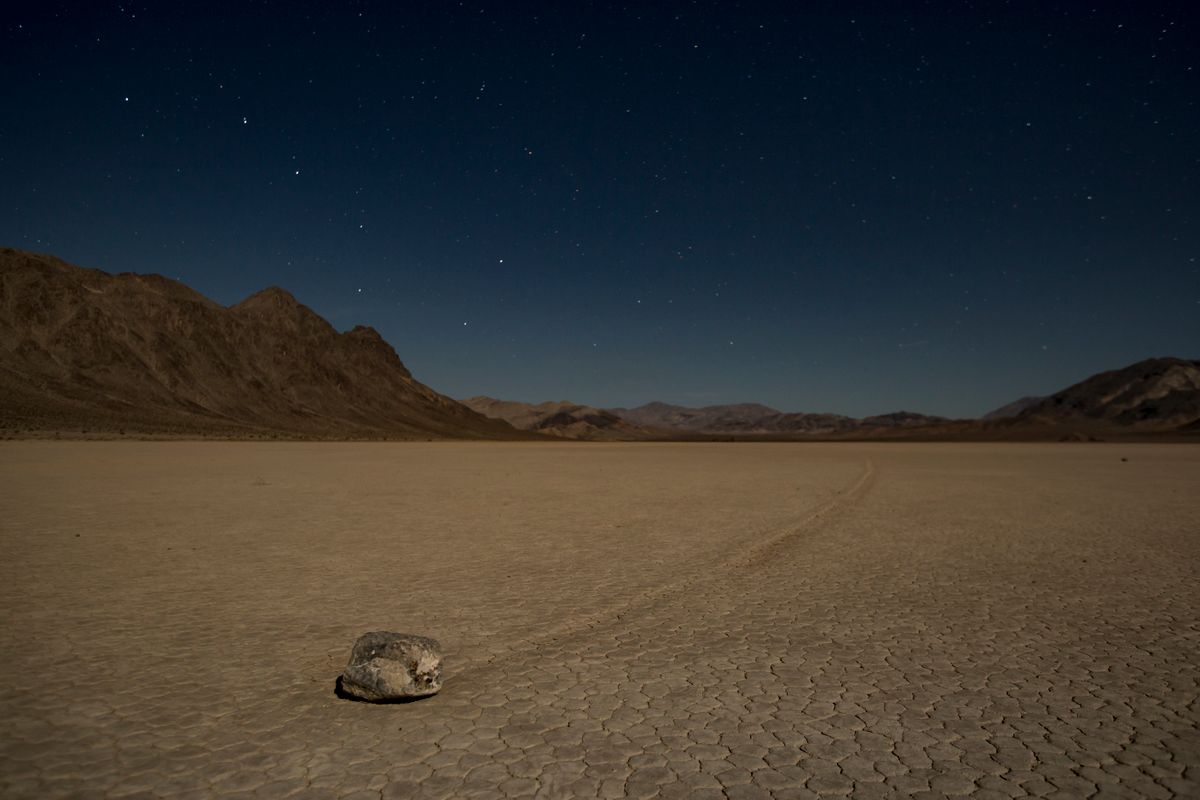
Picture a dry lakebed, flat as a pool table and cracked into a mosaic by the sun, somewhere in the middle of Death Valley. Scattered across it are rocks weighing several kilograms, some as big as a microwave, and behind every single one stretches a perfectly carved furrow in the mud, as if the rock had simply decided to go for a walk by itself. No footprints, no tire tracks, no animal tracks. Just the rock, sitting still at the end of its own trail: these are the sailing stones of Death Valley, and for nearly a century nobody could explain how they moved.
That place is real. It’s called Racetrack Playa, and it sits inside Death Valley National Park in California. The first documented witness was a prospector named Joseph Crook, who passed through in 1915 and stood there staring at those grooves with absolutely no explanation in sight.
The theories that didn’t explain the sailing stones
For decades, the Racetrack Playa phenomenon was one of the internet’s favorite geological mysteries, and pretty much anything counted as a hypothesis: hurricane-force winds, strange magnetic fields, thick ice shoving the rocks along like icebergs, even the running joke about bored aliens with nothing better to do. However, the problem was that nobody had ever actually watched a rock move. The phenomenon could only be studied after the fact, by reading the trail, never while it was happening.
The answer finally arrived in 2014, and in the most down-to-earth way possible: GPS trackers, time-lapse cameras, and a lot of patience. Researchers Richard and James Norris, who happen to be cousins, teamed up with engineer Ralph Lorenz and astronomer Brian Jackson to set up a weather station next to the dry lake and fit fifteen rocks with high-precision GPS receivers. Then they simply waited.
Thin ice, a light breeze, and one morning in December
On December 20, 2013, the team captured something nobody had ever recorded before: more than sixty rocks moving at once, some of them traveling as far as 224 meters over the following weeks. The explanation turned out to be far subtler than anyone had guessed. For the playa to spring into action, it needs just enough rain to form a puddle only a few centimeters deep. If that water freezes overnight, it forms an extremely thin, almost see-through sheet of ice. As the morning sun hits it, that ice melts at the edges and breaks apart into loose floating panels drifting over the mud.
Here’s the part that surprised even the scientists: it didn’t take a gale. A gentle breeze — the kind that would barely ruffle your hair — was enough. Those ice panels, pressing against the rocks they’d trapped or were resting against, dragged them slowly across the slick surface below, carving that unmistakable furrow into the mud once the water dried up. The study, published in the journal PLOS ONE, recorded rocks moving at speeds between two and five meters per minute: slow, sure, but a far cry from the total stillness the word “rock” is supposed to imply.
A show that’s getting rarer
There’s a bittersweet detail in the story of the sailing stones. Researchers who keep an eye on the area note that the phenomenon has become noticeably less frequent since the 1990s, likely because it depends on a very precise combination of just-right rainfall, overnight freezing, and a morning thaw — a combination that’s occurring less and less reliably in a region that’s already extremely arid to begin with. In other words: Death Valley, the hottest and driest place in North America, owes its most famous magic trick to a few millimeters of ice that are forming less and less often.
If you enjoy geological mysteries that take decades to crack, you might also like another real one just as strange: a Pennsylvania town that’s been burning underground since 1962.
So if you ever find yourself crossing that cracked, moon-like landscape and spot a rock stranded at the end of its own path, you’ll know it didn’t take any aliens to move it: the sailing stones only needed a tiny puddle, one cold night, and a breeze too weak to even lift a kite.